

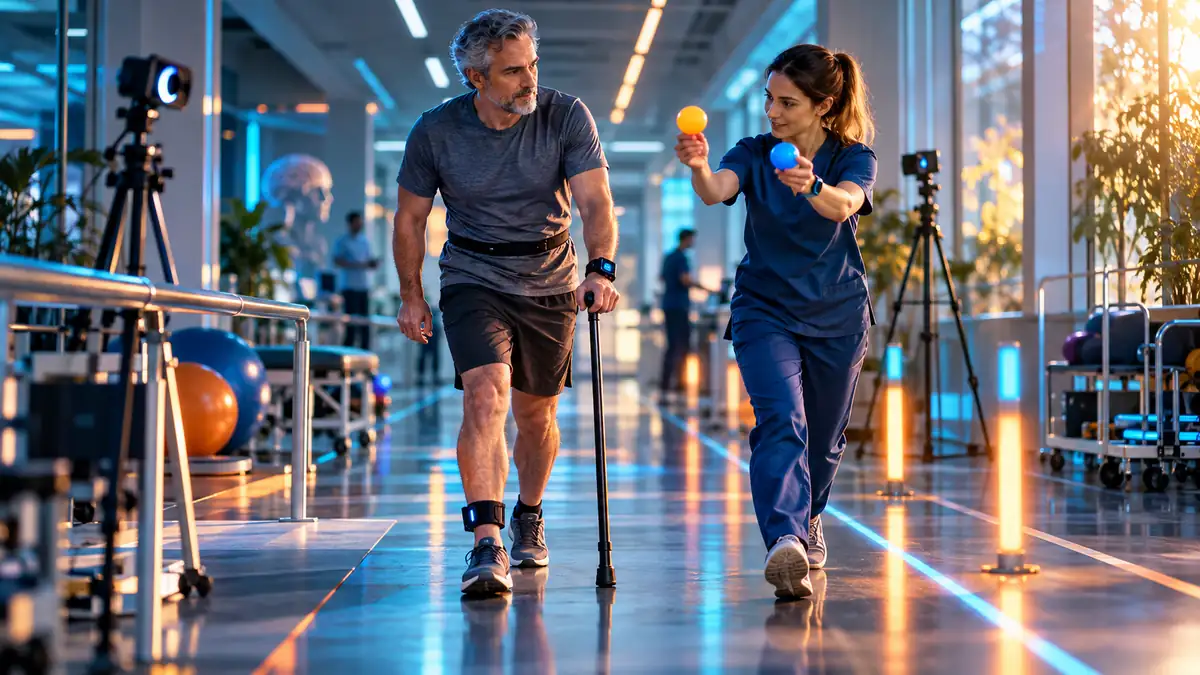
Combining motor and cognitive tasks
The problem being targeted is cognitive-motor interference: performing a cognitive task while moving can make walking more difficult after stroke. The approach under study combines a circuit of motor tasks with simultaneous cognitive demands, rather than training these dimensions separately.
The authors describe the subacute phase as a period of increased potential for neuroplasticity and response to rehabilitation. This biological rationale supports testing the intervention, but does not demonstrate that it leads to greater recovery.
Three groups, with feasibility as the priority
The protocol plans to randomly assign 36 participants to three groups: task-oriented circuit training with simultaneous cognitive demands, task-oriented circuit training, or dual-task training. Each group will receive three supervised sessions per week for four weeks, for a total of twelve sessions.
The primary outcomes will focus on feasibility and safety. Researchers will monitor attendance, participant retention, adverse events, heart rate, blood pressure and perceived exertion, among other measures. These measures are intended to determine whether the intervention can be studied in a larger trial.
Walking measures, but no established benefit yet
Exploratory outcomes will include endurance on the six-minute walk test, speed on the ten-metre walk test and walking adaptability on a standardised obstacle course. The abstract reports no results for these measures.
Serum BDNF will also be measured as an exploratory peripheral biomarker associated with neuroplasticity. A change in this marker alone would not be enough to establish a functional improvement or demonstrate a change in the brain.
Preparing a more robust trial
The stated aim is to refine the intervention, select the primary outcome and estimate the sample size needed for a future adequately powered trial. Even a favourable trend in this small pilot would not definitively establish the superiority of one approach.
At this stage, this protocol presents a relevant research question for rehabilitation after stroke. It provides no demonstrated reason to favour this circuit over the approaches being compared.
Limitations to keep in mind
Only the PubMed abstract was consulted, not the full text. It describes a planned pilot trial with a small sample and exploratory effectiveness outcomes. Funding and conflicts of interest were not checked.
What we can take away
This protocol lays the groundwork for evaluating combined motor and cognitive training after stroke. No results yet support a conclusion about its effectiveness or safety.
Sources and provenance
- The effect of dual task-oriented circuit training on neuroplasticity and walking adaptability in subacute stroke patients: A pilot and feasibility study.
Source date: 2026-10-27.
Journal Article, Randomized Controlled Trial · Résumé PubMed uniquement, texte intégral non consulté