

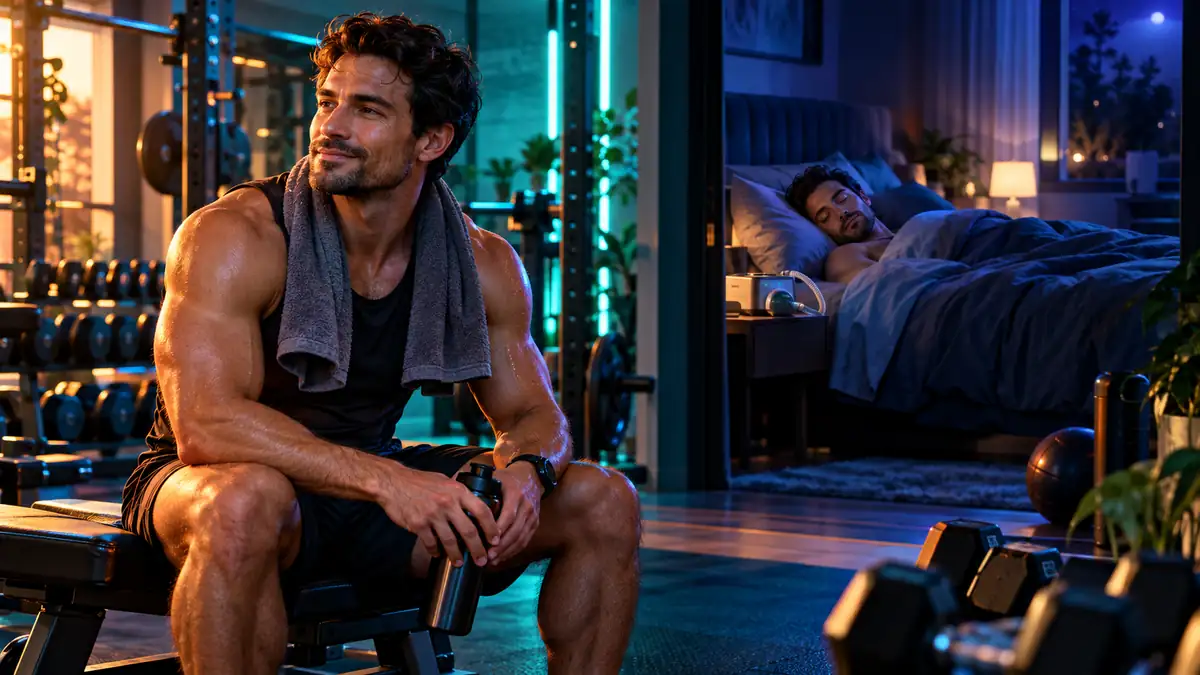
A short trial in adults with substantial sleep apnea
Participants had a mean age of 54.6 years and a mean body mass index of 36.1 kg/m². Their baseline apnea-hypopnea index averaged 52.2 events per hour. These results therefore apply to a population with substantial sleep apnea, not people without a breathing disorder who simply want to sleep better.
The researchers assigned participants to a strength-training group, with three sessions per week for eight weeks, or a control group, with two weekly sessions. The abstract does not specify what the control sessions involved or the exercises and weights used in the strength-training group. It therefore does not allow the intervention to be replicated or the comparison to be precisely characterized.
An improvement in self-reported sleep, not sleepiness
Subjective sleep quality was assessed using the Pittsburgh Sleep Quality Index, or PSQI. Its overall score decreased by 3.2 points in the strength-training group, compared with an increase of 0.2 points in the control group. Here, a decrease indicates an improvement in self-reported sleep.
Between-group differences were also observed in the questionnaire components covering time taken to fall asleep, sleep duration and sleep medication. These findings are changes in scores: they do not directly indicate a number of extra minutes of sleep or an amount of medication avoided.
The overall SF-36 quality-of-life score and its emotional dimension also improved. However, no difference was observed on the Epworth Sleepiness Scale. The reported improvement therefore does not extend to all symptoms assessed.
What this study does not demonstrate
The findings presented are based on questionnaires. The abstract does not report any change in the apnea-hypopnea index after the intervention. It therefore cannot be inferred that strength training reduces nighttime breathing interruptions or replaces sleep apnea treatment.
The small sample, eight-week duration and secondary nature of the analysis suggest these findings should be viewed as an encouraging signal that needs confirmation. The abstract also does not specify concurrent sleep apnea treatments or adverse effects.
Limitations to keep in mind
Only the PubMed abstract was consulted, not the full text. The secondary analysis covers 25 adults followed for eight weeks. The activities in the control group, concurrent treatments and adverse effects are not specified in this abstract. Funding and conflicts of interest were not checked.
What we can take away
In this small trial, strength training appears to improve perceived sleep quality in adults with moderate to severe obstructive sleep apnea. This finding demonstrates neither a reduction in apneas nor an improvement in daytime sleepiness.
Sources and provenance
- Effects of resistance training on subjective sleep quality, excessive daytime sleepiness, and quality of life in patients with obstructive sleep apnea: a secondary analysis from a randomized controlled trial.
Source date: 2026-10-20.
Journal Article, Randomized Controlled Trial · Résumé PubMed uniquement, texte intégral non consulté