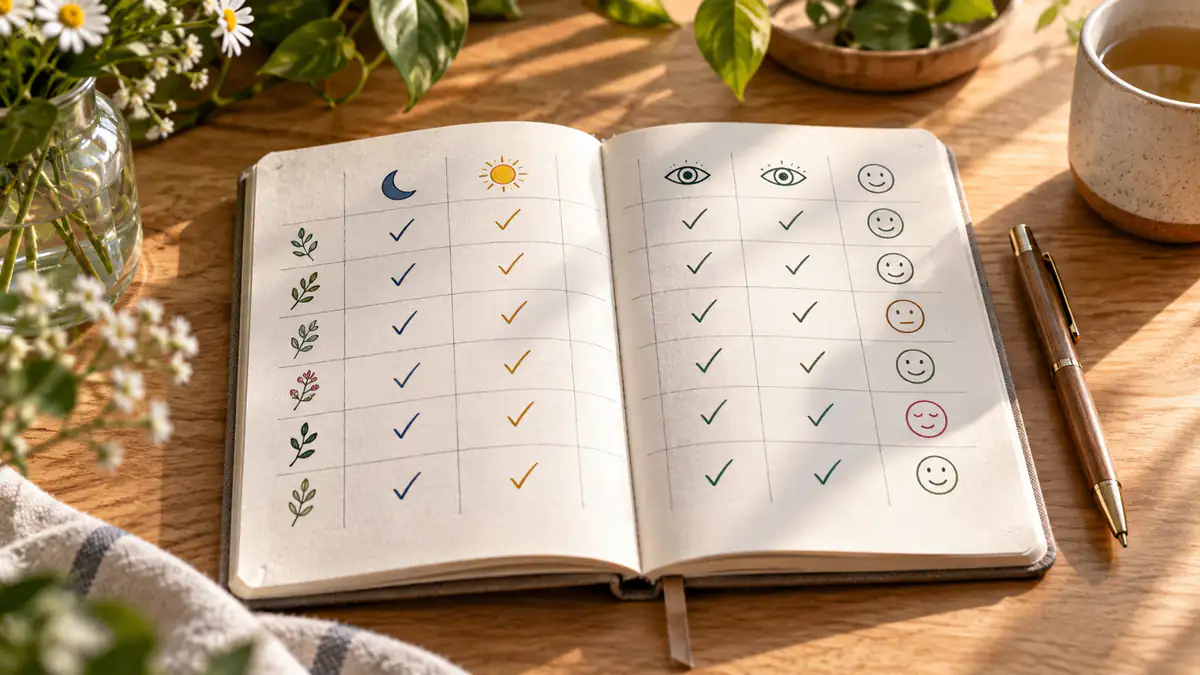
You spent eight hours in bed, but you do not feel recovered. Your watch reports a “good night”. Which should you trust? Start with how you function over several days, not the minutes of deep sleep displayed one morning. Look at the time actually available for sleep, how you feel on waking, unintentional dozing and the impact on your activities.
These observations can reveal a pattern or help you prepare for an appointment. They do not directly measure your sleep stages or provide a diagnosis. Persistent fatigue or dangerous sleepiness calls for more than a score.
What does “restorative sleep” mean?
It is neither a specific stage nor a target amount of deep sleep. In its position statement on sleep health, the American Academy of Sleep Medicine (AASM) identifies several dimensions: duration, quality, appropriate timing, regularity and the absence of sleep disorders. “Restorative” mainly describes your experience of a night that lets you function the next day, without guaranteeing that all these criteria are met.
Your body regulates sleep through the pressure that builds during wakefulness and a circadian clock that influences when you sleep. Repeated awakenings, shifted schedules or too little sleep can leave you feeling poorly recovered. Conversely, an objectively fragmented night does not feel the same to everyone. How you feel is a data point, not a polysomnography study.
Separate these three questions before looking for an explanation:
| What you observe | What it can tell you | What it does not prove |
|---|---|---|
| Time between going to bed and getting up | How many hours you allow for sleep | That you were asleep the whole time |
| How you feel on waking | Whether you feel rested or still groggy | Your percentage of deep sleep |
| Daytime alertness and functioning | Whether you stay awake during everyday activities | The exact cause of sleepiness or fatigue |
For most adults, the AASM and Sleep Research Society consensus recommends regularly getting at least 7 hours of sleep per night to support health. This is a population-level reference point, not proof that you had a good night. Eight hours in bed can include long periods awake. If you want to estimate how much sleep you need by age, start with our guide to how many hours of sleep you need · FR. Here, I am interested in what happens even when the duration seems sufficient.
What should you observe on waking and during the day?
A single night can be affected by stress, illness, childcare or an unusual bedtime. Look instead at what recurs over several days. On waking, note how you feel before checking an app: rested, somewhere in between or not rested. If you take a while to come round but then work normally, do not turn those first few minutes into proof that your sleep was “bad”.
During the day, ask yourself a more concrete question: can you stay awake and attentive during a meeting, a conversation or a journey, under your usual circumstances? An energy dip is not necessarily sleepiness, meaning a tendency to fall asleep. Conversely, keeping yourself going with coffee can mask an urge to sleep. Unintentional dozing carries more weight in deciding whether to seek medical advice than an “average” morning.
Also consider the circumstances around your day: schedule changes, night work, naps, pain, sedating medication, alcohol or sleep debt from previous days. You do not need to track every brief awakening or explain every sensation. The aim is to see whether poor recovery keeps recurring despite a reasonable opportunity to sleep and whether it interferes with real life.
A brief diary for 14 days, with no magic score
Assurance Maladie and Inserm describe a sleep diary as a way to explain your schedule and difficulties to a healthcare professional. The Consensus Sleep Diary standardises prospective self-monitoring in research and clinical practice, particularly for insomnia. The simplified worksheet below is our editorial tool, not the Consensus Sleep Diary or a validated diagnostic instrument. The 14 days let you capture both workdays and days off; this is not a diagnostic threshold.
Download the 14-day sleep diary as a PDF or open the printable HTML version. Two pages, one line per night, to fill in with a pen. No app or account required.
To keep the diary useful without encouraging anxious monitoring, follow these steps:
- In the morning, enter the date of the night, the time you tried to sleep, the time of your final awakening and when you got out of bed. Estimate whether you spent a long time awake during the night, without checking the clock each time. Write “?” if you do not know.
- Before checking your wearable data, tick “rested”, “somewhere in between” or “not rested”. This is not a score out of ten or a diagnosis.
- At the end of the day, note whether you struggled to stay awake or dozed off unintentionally, and when. Record only notable circumstances: a nap, jet lag, illness, medication that makes you sleepy, alcohol, snoring or a breathing pause observed by someone close to you.
- After one to two weeks, look for recurring patterns: the same difficulties on early-start days? Sleepiness even after a sufficient sleep window? Do your morning state and daytime alertness tell different stories? Bring the diary to an appointment if the problem persists.
Here is how to read two fictional entries without calculating a score:
| Fictional night | On waking | During the day | What the diary suggests asking |
|---|---|---|---|
| Getting up two hours earlier, short sleep window, not rested | Hard to come round | Urge to sleep in the afternoon | Is enough time available for sleep on workdays? |
| Long sleep window, not rested every morning | Awakenings unnoticed or uncertain | Unintentional dozing | Should a sleep disorder or another cause be discussed? |
A night with few perceived awakenings does not rule out breathing events you are unaware of. Conversely, plenty of time in bed guarantees neither plenty of sleep nor sufficient recovery. Avoid turning your diary into a self-scored “sleep efficiency” figure calculated to the decimal place: its purpose here is to describe a pattern, not produce a clinical value.
Stopping rule: if recording times makes you watch the clock at night or increases your fear of sleeping badly, simplify it to three entries (getting-up time, daytime alertness, unusual symptoms) or stop using the worksheet. Sleep is not a test you have to pass. The diary should never delay an already warranted medical appointment.
Why your watch and how you feel may disagree
Deep sleep, called stage N3, is defined by the brain’s electrical activity. Inserm explains that polysomnography uses brain electrodes, muscle measurements and eye movements, among other measures, to study sleep. A watch, by contrast, estimates sleep periods and stages from movement and peripheral signals. It does not read your brainwaves directly.
Algorithms, versions and study populations vary. In a 2026 systematic review, five observational studies involving a total of 2,006 adults found weak to moderate agreement between watch metrics and self-reported sleep quality. This review does not say that how you feel diagnoses a disorder better than a device. It says these two measurements do not answer the same question. Perceived quality is neither a measurement of sleep stages nor an infallible verdict.
The AASM position statement on consumer devices stresses that they do not replace medical assessment for diagnosing or treating a sleep disorder. Reassuring data should not override real sleepiness. If you want to understand what each sensor measures and why brands differ, read our analysis of the reliability of sleep watches and rings · FR. If checking your score makes you anxious first thing in the morning, our guide to orthosomnia and tracker obsession · FR addresses that particular situation.
Sleeping before midnight: a false cutoff
Your circadian clock and sleep pressure matter, but they do not give everyone a biological cutoff at 12:00 a.m. If going to bed at 10 p.m. leaves you lying awake for a long time, you have not “gained” restorative sleep. If you need to get up early, focus instead on protecting a sufficiently long sleep window at a time that suits you. Regularity, duration and the fit between your biological timing and your commitments matter more than the symbolic hour of midnight. Inserm explains the role of circadian rhythm without setting a universal bedtime.
When should you move from a diary to a medical appointment?
Do not wait until the 14 days are over if safety is at stake. If you feel sleepy at the wheel or during a risky activity, stop somewhere safe, do not drive while sleepy and seek medical assessment. A watch showing eight hours of sleep does not cancel out this warning sign.
Other situations call for a medical appointment rather than another sensor:
- Repeated sleepiness despite seemingly long enough nights: unintentional dozing, struggling to stay awake or an impact on work and everyday life.
- Loud snoring, observed pauses in breathing or waking with a choking sensation: discuss a possible sleep-related breathing disorder. The assessment process and tests are detailed in our article on the signs and screening of sleep apnoea · FR.
- Sleep difficulties lasting several weeks and affecting your day: Assurance Maladie recommends discussing them with your doctor. The guide to insomnia and the effort to fall asleep · FR addresses this separate issue without replacing a medical appointment.
- An unusually high need for sleep or fatigue without an urge to fall asleep, especially if it is worsening: the problem is not necessarily limited to sleep. Discuss your medical context, medications and other symptoms with a healthcare professional.
Your doctor may use a clinical interview, an examination and a more detailed diary, and may suggest a sleep study depending on what is suspected. Polysomnography is not automatic for everyone who wakes up tired. The European guideline on insomnia prioritises clinical interviews and questionnaires or diaries, reserving sleep studies for specific situations, particularly when another disorder is suspected.
The verdict: your day matters as much as your night
Restorative sleep is not a perfect graph. If you have enough time to sleep, your schedule is relatively regular and you stay awake and functional during the day, there is no reason to let a one-off poor watch score dictate how you feel. Conversely, recurring sleepiness deserves attention even when your nights look “great” on screen.
My editorial choice: fourteen days of brief notes before fourteen days of chasing sleep stages, unless a warning sign calls for an earlier appointment. You come away with observations you can share, not a self-diagnosis. And if keeping a diary adds anxiety, stop measuring: the next useful step may be a conversation with a healthcare professional.