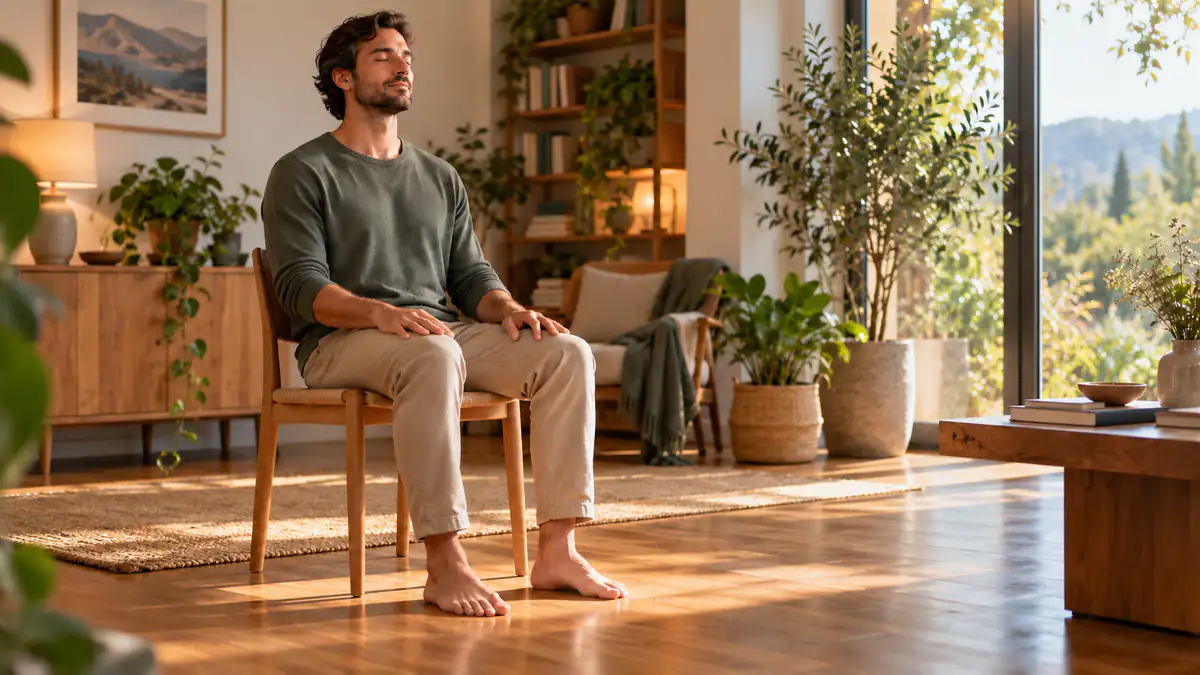
Meditating does not mean emptying your mind. You choose a focus, notice that your attention has wandered, then return. Thoughts are not a flaw to eliminate: their appearance is part of the exercise.
To give it a try, all you need is a chair and a few minutes. No lotus position, special music or subscription required. This guide offers an original five-minute session, three variations and a printable worksheet. The aim is to learn the skill, not to treat an anxiety disorder. If the exercise noticeably increases your distress, stop rather than trying to make it to the timer.
Mindfulness: observing without trying to empty your mind
Mindfulness means deliberately paying attention to your present experience, with as little judgement as possible. Université Laval distinguishes formal practice, such as sitting or walking meditation, from paying attention during an everyday activity.
In practice, you feel your feet on the floor. A thought about a work project comes up. You notice you are now preparing a reply to your colleague. You return to the contact of your feet. This return is the skill to repeat, not proof that the session has failed.
There are three different intentions to distinguish:
- Observing the breath: feeling your breathing as it is, without imposing a rhythm.
- Practising guided breathing: deliberately changing its rhythm, which is a different exercise.
- Relaxing: seeking calm, whereas mindfulness does not require you to feel calm in every session.
The useful mechanism here involves attention: choosing an anchor, detecting a distraction and redirecting your attention. There is no need to tell a story about transforming the amygdala to explain this skill. The NCCIH also stresses that the practical implications of brain-related findings remain difficult to interpret.
Structured clinical programmes involve more than five minutes alone on a chair. For benefits and their limitations, see the guide to the evidence on meditation. Here, we are sticking to learning the skill.
A five-minute guided session, minute by minute
This script is an original learning exercise, not a validated medical protocol. Its length is intended to make it easy to fit in a trial session. Read it before starting, or ask someone to read it slowly, leaving pauses. Reading the whole text straight through does not make it a five-minute session.
Settle somewhere you do not need to watch out for danger. Do not practise while driving. Set a quiet timer, turn off notifications and make sure you can stop at any time. A stable chair is fine. If possible, place your feet on the floor and your hands on your thighs, and let the backrest support your back. Adapt these points of contact to your mobility: no posture is compulsory.
Minute 1: settling in
“Look around briefly. Notice where you are. Keep your eyes open or close them if that suits you. Feel the weight of your body on the chair and the contact of your feet. You do not need to become perfectly still. Adjust your position if it pulls or hurts. For this minute, simply observe a point of contact that is easy to feel.”
Then stay with that contact. The aim is not to create an intense sensation.
Minute 2: finding an anchor
“If it feels comfortable, notice a breath. Choose just one place where you can feel it: your nostrils, chest or belly. Let the air flow in and out without trying to breathe more deeply. If focusing on your breath brings up anxiety, keep your attention on your feet or a sound in the room instead.”
Do not check every location with each breath in. One anchor is enough.
Minute 3: noticing and returning
“A thought, a noise or an urge to check the time may draw your attention. When you notice it, simply acknowledge it. You can silently say ‘thinking’ or ‘planning’, just once. Then return to your anchor. You do not have to finish the thought or push it away.”
If you realise you spent the whole minute elsewhere, return now. There is nothing to make up for.
Minute 4: starting again without forcing it
“Continue with the same anchor. Observe what you can perceive right now, not what you think you should be feeling. Whenever your attention wanders and you notice, return. If a sensation becomes painful or worrying, change position or end the session. Pushing through distress is not the goal.”
You can let a thought remain in the background while returning to the contact with the seat.
Minute 5: ending deliberately
“Gently broaden your attention to the sounds and the room. Look around if your eyes were closed. Move your hands and feet at your own pace. Before getting on with your day, note something simple: which anchor did you use, and was it tolerable?”
You may finish feeling calm, restless or no different in particular. Do not turn that final state into a success score.
Three exercises to choose from depending on the situation
Choose just one variation to start with. These durations are practical reference points, not established doses for achieving a clinical benefit. The instructions follow the principle described by Université Laval: observe, let your breathing remain natural and return without judgement.
The breath: an anchor, not something to control
For one to three minutes, feel the air at your nostrils or the movement of your belly. Choose whichever sensation is easiest to notice. When you realise you are listing your tasks, return to the next breath you can feel.
Do not aim for the deepest possible breath or hold your breath. If you start compulsively monitoring your breathing or worrying about running out of air, leave this anchor behind. External sounds or the contact of your hands can serve as alternatives. This is not an inferior version of the practice.
Sensations: three concrete points of contact
For about two minutes, explore in turn your feet on the floor, your body on the seat and your hands on your thighs. Spend a few moments with each point of contact. Observe pressure, temperature or texture without searching for the “right” sensation.
This is not about inspecting your entire body. If you feel almost nothing in one place, move on to the next. If focusing on your body is distressing, observe the colour and shape of an object in the room instead, with no obligation to keep exploring internally.
Walking: staying attentive while moving
Choose a flat, clear and familiar route. For two to five minutes, walk at a comfortable pace with your eyes open. Notice in turn your foot lifting, contact returning and your weight shifting.
You do not have to walk in slow motion. When a thought carries you away, return to a point of contact in your next step. Keep watching your surroundings: safety comes before observing sensations. Near a road, on stairs or in a crowd, stop the exercise and move around normally. If walking does not suit you, stick with the seated variation.
What should you do when thoughts return?
They will return. The mistake is not their presence, but expecting to have none. Université Laval explicitly states that mindfulness does not aim to suppress thoughts, emotions or sensations.
You can use a short response: “I was planning tomorrow. Now I am feeling my feet.” There is no need to comment on every thought or count every distraction. Mental labelling is an optional aid, not another task to get right.
Everyday difficulties call for simple adjustments:
- You are bored: notice the urge to stop, then choose to continue briefly or finish. No tug-of-war.
- You are dozing off: open your eyes or practise when you are more alert. Meditation does not replace rest.
- A noise bothers you: use it as an anchor for a few moments, rather than seeking perfect silence.
- You think of an urgent task: write it down after the session, or finish to deal with it if it cannot wait.
Pain, rising panic or an overwhelming traumatic memory are not distractions to handle by gritting your teeth. The rule about stopping still takes priority.
Flexible progression and a practice journal
To begin, try one to five minutes at an existing point in your routine: after your morning coffee or before returning to work, for example. Choose a few opportunities during the week rather than a daily commitment you know is impossible. If you forget a session, resume at the next opportunity without doubling the duration.
After a week, ask yourself whether the format fits into your life and remains tolerable. You can keep the same duration, shorten it or add a minute if you wish. There is no compulsory milestone. This schedule is an organisational choice, not a therapeutic progression.
A useful journal entry fits on one line. Note the date, approximate duration, chosen anchor and a concrete observation, for example: “Three minutes, feet, able to return after a thought about work.” Add any discomfort during or after the session. Do not aim for a performance score.
The printable practice worksheet brings together the session outline, adaptations and a seven-day journal. You can also download the A4 PDF directly, then print it.
If you prefer a voice to guide you, Université Laval also offers free audio recordings on its page. Guidance can help you follow the instructions without making the exercise more “powerful”. You can change voices, return to silence or stop if the instructions do not suit you.
Discomfort, precautions and when to seek help
Feeling less calm after a session proves neither failure nor progress. Pay particular attention to whether the experience remains tolerable and whether its after-effects interfere with your daily life.
The systematic review by Farias and colleagues, whose abstract was consulted via Europe PMC, reports adverse events, including anxiety and depressive symptoms, across different meditation practices in adults. Methods and contexts vary widely. It cannot be used to estimate your risk with this five-minute script. The NCCIH also notes that safety remains insufficiently studied.
If anxiety rises noticeably, stop. Open your eyes, look around the room and return to a familiar activity. Do not force your breathing or immediately start another session to fix the previous one. Changing anchors or shortening the session is an option, not a guarantee that it will be tolerable.
Seek help from a doctor or psychologist if you notice any of the following:
- repeated panic, persistent anxiety or significantly disrupted sleep after practising.
- overwhelming traumatic memories, a sense of unreality or confusion.
- worsening of a mental health condition already under care, or difficulty functioning in daily life.
If you have a history of psychosis, a manic episode or severe trauma, prioritise a discussion with your healthcare professional before practising on your own, especially intensively. A teacher does not replace a healthcare professional. Meditation must neither replace treatment nor delay a consultation. If you feel you are in immediate danger, contact emergency services.
A good start: returning, not succeeding
I suggest trying just one anchor for a short time, without buying any equipment. If the breath suits you, observe it. Otherwise, use points of contact or sounds. The skill to learn remains the same: noticing where your attention is and choosing to return.
Continue if this format is tolerable and seems useful to you. Adapt it or set it aside if it does not suit you. A flexible practice requires neither an empty mind nor endurance in the face of distress.
Main sources
The educational resources and safety source consulted are as follows: