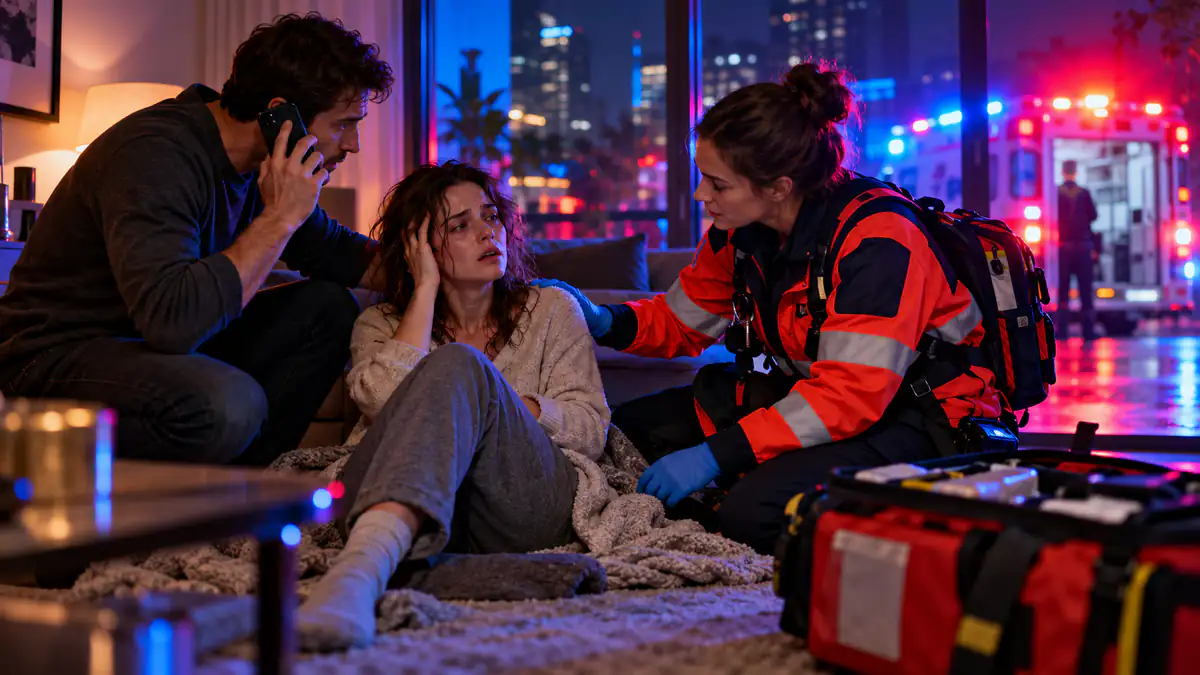
In France, call 15 or 112 immediately if the person is unresponsive, has trouble breathing, has seizures or puts themselves in danger. Do not finish this article before calling. Even without any obvious serious signs, possible poisoning warrants an immediate call to a poison control centre, even without symptoms.
After suspected use of hallucinogenic mushrooms, people around the person cannot remotely establish that it is “just a bad trip”. Psychological distress, physical effects, a combination of substances and mushroom misidentification can overlap. The goal is to get professional guidance, not to name the syndrome yourself.
This guide covers French contacts. Outside France, use the emergency services and poison control centre in the country where the person is located. 112 is the European emergency number. Do not assume that 15 or French contact details work everywhere.
Emergency warning signs: who should you call in France?
A serious sign or immediate danger: 15 or 112
Call emergency services without delay in the following situations:
- The person is not responding normally, becomes difficult to wake, loses consciousness or has trouble breathing.
- They have seizures, collapse, feel seriously unwell or have chest pain.
- They are very confused or agitated and you cannot keep them safe, particularly near a road, window or water.
- They threaten to harm themselves, attempt to do so or behave dangerously towards themselves or others.
You do not have to wait for several of these signs. If you are unsure how serious it is, 15 can assess the situation and guide you. Describe what you see rather than just saying “they took mushrooms”.
The numbers are confirmed by Service Public. 114, accessible notably by text message, app and internet, allows people who are deaf, deafblind, hard of hearing or have aphasia to contact emergency services.
No obvious serious signs: call a poison control centre without delay
If a potentially toxic substance has been swallowed, call a poison control centre even if the person seems fine. The association of poison control centres reminds people not to wait for symptoms to appear.
Contact details for French centres are available in this official directory. Direct lines open around the clock include the Paris poison control centre: 01 40 05 48 48. Difficulty reaching someone must not delay a call to 15 or 112 if the person’s condition worsens or becomes concerning.
Guidance in France
After confirmed or possible ingestion
Describe the situation and follow instructions. Do not wait to confirm the product.
Possible poisoning requires immediate advice, even without symptoms. Call 15 or 112 if there is any deterioration.
Psychological distress and physical symptoms: do not downplay them
A “bad trip” describes an experience, not a guarantee of safety
Intense fear, disorientation or a sense of losing control can feel terrifying. Information from Drogues Info Service describes these reactions and the possibility of psychiatric complications.
The risk is not just about what the person feels. Altered perception can also increase the risk of an accident or dangerous action. OFDT highlights these risks and the lack of quantification of some adverse effects. The phrase “natural product” resolves none of these uncertainties.
Stay calm, speak simply and avoid confrontations about what the person believes they see. Reducing noise and removing hazards, when you can do so without putting yourself at risk, helps keep things safe while waiting. Reassurance does not replace the call. Do not promise that everything will be over within a specific time.
Physical symptoms need assessment too
Nausea, dizziness, a faster heartbeat and changes in blood pressure are among the reported effects of psilocybin in the fact sheet from NCCIH, part of the NIH. Their presence does not establish a single cause.
Chest pain or breathing difficulties must therefore not automatically be attributed to anxiety. Vomiting or diarrhoea after eating mushrooms also requires poison control advice. If accompanied by feeling seriously unwell or altered consciousness, call emergency services.
Do not rely on an effect duration found online to decide to wait. It does not account for a misidentified product, other substances or the person’s health. For an explanation of the mechanisms, the guide to the effects of hallucinogenic mushrooms on the brain · FR serves a different purpose. It is not a timetable for monitoring someone at home.
Misidentification: a separate risk
The name given by a seller, friend or post does not verify what was swallowed. Some toxic mushrooms can be mistaken for those sought for their psychoactive effects, with potentially serious consequences. NCCIH explicitly flags this risk.
The toxins in a misidentified mushroom are not limited to the effects of psilocybin. A reassuring appearance, an absence of hallucinations or a temporary improvement does not rule out poisoning. Assurance maladie recommends calling a poison control centre even without symptoms after swallowing a toxic product, because signs can appear later.
Do not try to settle the question with a photo, an app or an AI answer. Keep leftovers, packaging and any images already available for professionals. Do not go back to find a specimen or delay calling to gather more information. If several people shared the product, mention it, even if they do not have the same symptoms.
Medical history, combinations and vulnerabilities
Psychiatric history must be reported
NCCIH identifies particular risks in people with psychotic disorders and certain severe forms of bipolar disorder. This does not allow an individual’s risk to be calculated from a questionnaire or personal account.
Therapeutic research takes place in supervised settings. It is not permission to treat depression yourself or proof that a product of uncertain origin is safe. A known history does not mean the current reaction is necessarily psychiatric, and having no such history does not protect against every complication.
Tell the professional about known diagnoses, previous hospital admissions, medications and recent changes in behaviour. Persistent delusions, disorganised thinking or behaviour, severe agitation or perceptual disturbances require medical assessment. If there is immediate danger, calling 15 or 112 remains the priority.
Mixing substances makes the situation harder to interpret
Alcohol, cannabis, stimulants, medications and other products can alter the clinical picture. An online list cannot guarantee that a combination is safe. Interactions depend on the substances actually taken and the medical context.
Provide a list of medications, including those taken occasionally, and other known substance use. Be clear about what is uncertain. Do not stop prescribed treatment or add a medication to try to “stop” the effects without instructions from a professional.
Pregnancy, cardiovascular or neurological disease and a child’s exposure must also be reported immediately. This information helps determine care. It must not become a reason to wait until you have every detail before calling.
Practical guide for someone helping
The downloadable PDF guide for people helping someone includes French contacts, information to pass on and actions to avoid. Its printable HTML version can still be viewed on a mobile phone. It does not replace speaking with emergency services.
During the call: provide facts
Prepare what is available, without delaying the call:
- The exact address, access details and a callback number.
- Age, approximate weight, known medical conditions and medications.
- The time of ingestion or best estimate, followed by when the signs began.
- The suspected product, its source and the quantity, whether known, estimated or unknown.
- Other substances taken and the possibility that several people are affected.
- The current condition: are they responding, are they breathing normally, what symptoms are present and how are they changing?
You can start like this: “Someone may have taken mushrooms. We are at this address. They are responding / not responding. Their breathing is…”. Do not hang up until you are told to.
While waiting: follow instructions, do not improvise treatment
Do not leave the person alone. Protect your own safety too: move away from violent behaviour and call emergency services rather than attempting a physical confrontation.
If the person is unconscious but breathing normally, follow the instructions from 15 for placing them in the recovery position, mentioning any possible fall or injury. If they are not breathing normally, call 15 or 112, put the phone on speaker and begin guided resuscitation. The Assurance maladie fact sheet on loss of consciousness distinguishes these two situations.
Avoid the following actions:
- Inducing vomiting, giving milk or giving anything to drink while waiting for poison control advice.
- Giving alcohol, another drug, medication or charcoal without medical instructions.
- Letting the person drive or arranging transport on your own initiative despite suspected poisoning.
- Waiting for them to “sleep it off”, or treating their calmness as proof that there is no danger.
The poison control centres specifically remind people that milk is not an antidote. Treatment and monitoring decisions are theirs to make.
After the episode: support resources, not a substitute for emergency care
Persistent anxiety, sleep difficulties or unusual perceptions after the episode warrant medical advice. Do not wait for another use to check whether it happens again. If anyone is put in danger or there is an acute deterioration, call emergency services again.
To discuss your own or someone else’s substance use outside an emergency, Drogues Info Service: 0 800 23 13 13, 8 am to 2 am, every day, free and anonymous calls. These contact details are confirmed in the Service Public directory. This listening and referral service does not replace 15 or a poison control centre in cases of possible poisoning.
Finally, the products covered in our review of mushroom coffees · FR belong to a different commercial category. That comparison offers no guarantees about a product presented as hallucinogenic and no way to identify what was swallowed. Do not confuse the two topics just because they share the word “mushroom”.
The Verdict
Sources and contact verification
Contacts checked on official pages on 19 October 2026. This documentary summary has not undergone independent medical review. It cannot confirm a diagnosis or authorise monitoring at home.