

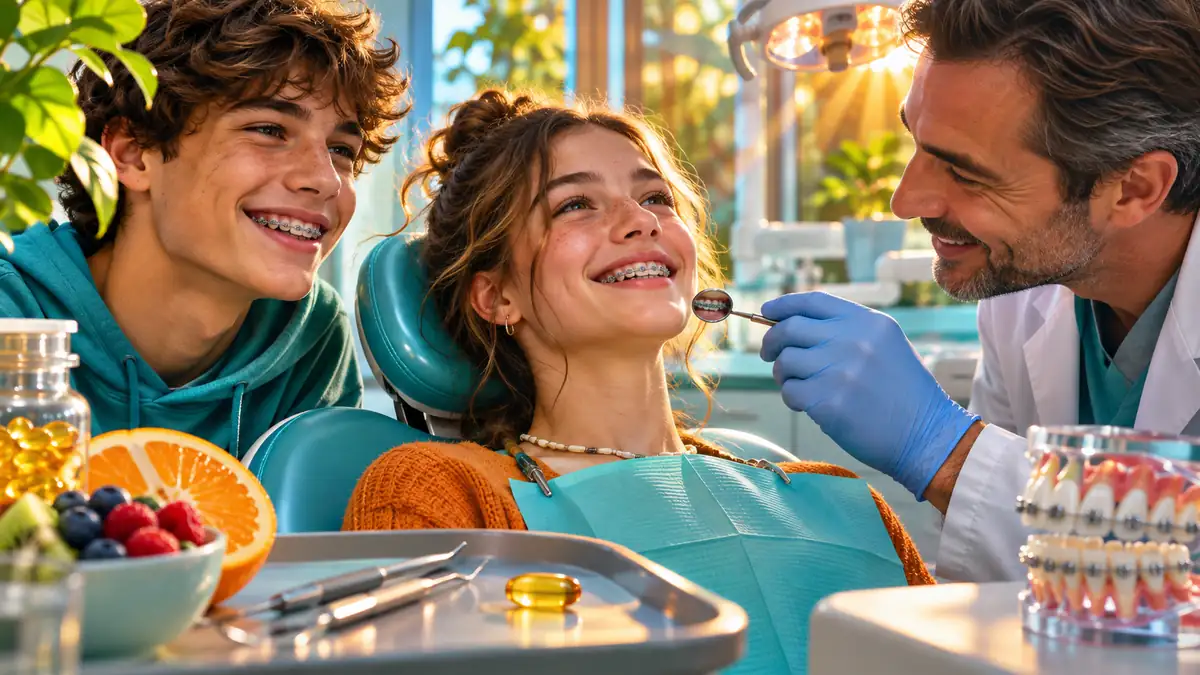
A trial in a clearly defined orthodontic situation
Participants were aged 13 to 18 and had Angle Class I malocclusion requiring extraction of all four first premolars. All were undergoing fixed orthodontic treatment. The findings therefore do not apply directly to everyone wearing braces.
The adolescents were randomly assigned to two groups of 26. The control group received no vitamin D₃ supplementation. The other group received 60,000 IU orally every 20 days. This was the experimental regimen studied, not a recommendation for use.
The researchers measured salivary vitamin D₃ at three stages of treatment. They also recorded the time between initial placement of the orthodontic archwire and removal of the braces.
An average difference of 1.69 months
Treatment lasted an average of 17.81 months in the supplemented group, compared with 19.50 months in the control group. The 1.69-month difference was statistically significant. This finding suggests a possible benefit in this population, without guaranteeing shorter treatment for every adolescent.
Salivary vitamin D₃ concentrations, which were comparable at baseline, were higher in the supplemented group during closure of the extraction spaces and at removal of the braces. This increase accompanies the clinical result, but does not by itself demonstrate how supplementation might have influenced treatment duration.
Neither a validated protocol nor a saliva test ready for routine use
Random allocation is a strength. However, the sample size remains small, and according to the abstract, the comparator was no supplementation, not a placebo. The abstract does not allow verification of assessor blinding, any dropouts or baseline blood vitamin D status.
The abstract also provides no detailed findings on adverse effects. It therefore does not establish the safety of the regimen tested. Funding and conflicts of interest have not been verified.
The authors consider saliva a potential noninvasive monitoring tool, while noting that its usefulness in guiding supplementation has yet to be established. Measuring a salivary concentration does not mean having a validated test to decide who should receive supplementation.
Limitations to keep in mind
Small sample size, specific population and PubMed abstract only, without review of the full text. Baseline blood vitamin D status, detailed safety data, blinding, funding and conflicts of interest cannot be verified from the source materials.
What we can take away
This trial offers a favorable signal, but one limited to a small group of adolescents undergoing a specific orthodontic treatment. It does not justify starting supplementation to get braces off sooner without a clinical assessment.
Sources and provenance
- Effect of oral vitamin D₃₃ supplementation on salivary vitamin D levels and orthodontic treatment duration: a randomized controlled trial.
Source date: 2026-11-10.
Journal Article, Randomized Controlled Trial · Résumé PubMed uniquement, texte intégral non consulté