

Scoliosis-specific exercises compared with general exercises
The trial recruited adolescents at a specialist center with a Cobb angle between 25° and 45° and a Risser grade of 0 to 2. The Cobb angle was the main radiological measure of spinal curvature tracked in the study.
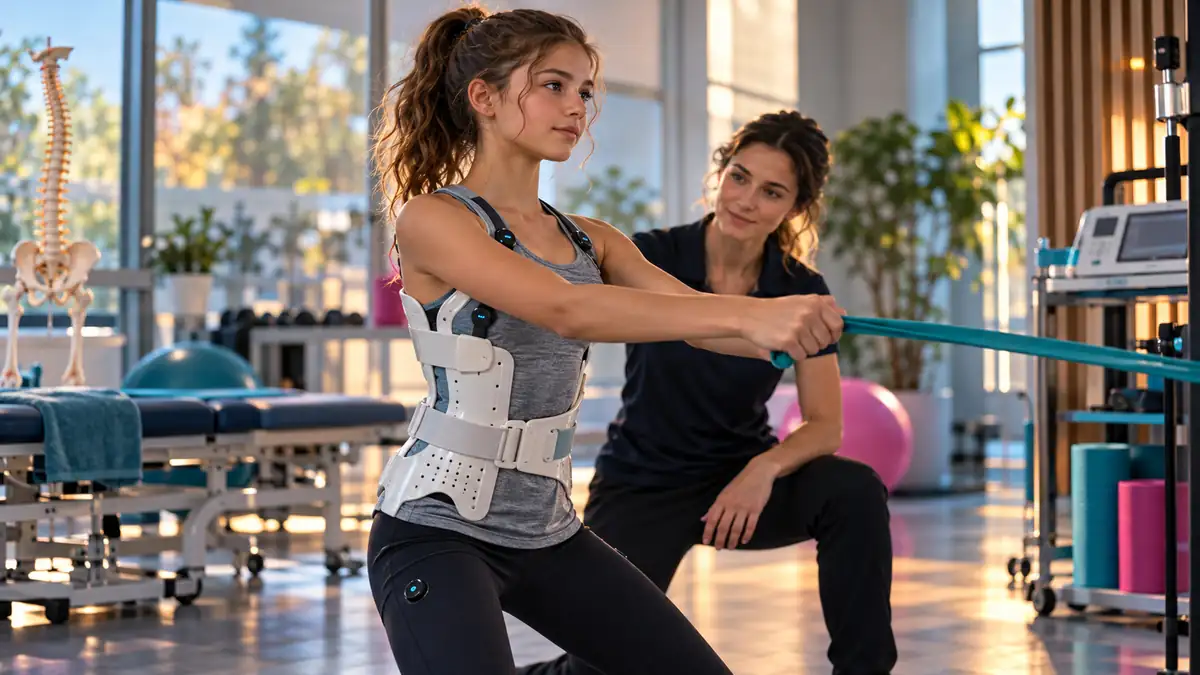
All participants were treated with a brace. One group followed scoliosis-specific exercises based on the Schroth method, with sessions supervised by a physiotherapist and daily exercises at home. The other performed general exercises independently.
The comparison therefore concerns two programs added to bracing, not exercises versus no treatment. It also cannot separate the effect of supervision from that of the specific exercise content.
A measurable difference, but below the clinical threshold
At 24 months, the adjusted between-group difference in the change in Cobb angle was −3.23°, favoring the supervised program. The 95% confidence interval ranged from −3.51° to −2.96°.
This difference was statistically significant but remained below the 5° predefined as the minimum clinically important difference. Detecting a difference between two groups therefore does not mean that it represents an important benefit for patients.
No additional clinically important improvements
The researchers also classified radiological outcomes as improvement, stability or worsening, using a 5° threshold for change. This analysis showed no difference between groups, whether participants were analyzed according to their original assignment or according to the protocol.
The supervised program also provided no lasting clinically important benefit in quality of life, measured using the Chinese Brace Questionnaire-34.
What this trial tells us
These findings temper the promise of a substantial additional benefit from supervised exercises in this brace-treated population. They do not demonstrate that all exercise is useless, or that the results would be identical without bracing or in other forms of scoliosis.
The abstract does not specify the sample size, adverse events, funding or conflicts of interest. Without the full text, the assessment of the robustness of the findings remains incomplete.
Limitations to keep in mind
Only one trial, conducted at a specialist center, is available in the source material, and only as an abstract. The sample size, treatment adherence details and safety data are not specified. Funding and conflicts of interest have not been verified.
What we can take away
At 24 months, supervised scoliosis-specific exercises provide a modest radiological advantage over self-directed general exercises in these adolescents treated with a brace, with no demonstrated clinically important benefit.
Sources and provenance
- Supervised physiotherapeutic scoliosis-specific exercises provide limited additional benefit at 24 months in braced adolescents with idiopathic scoliosis: a randomized trial.
Source date: 2026-11-01.
IM, Randomized Controlled Trial, Journal Article · Résumé Europe PMC uniquement, texte intégral non consulté