

Comparing the two sides of the mouth
Participants were aged 18 to 35 and required extraction of the upper first premolars, followed by backward movement of the canines. The study used a split-mouth design: half-arches received laser treatment, while control half-arches allowed comparisons within the same participants.
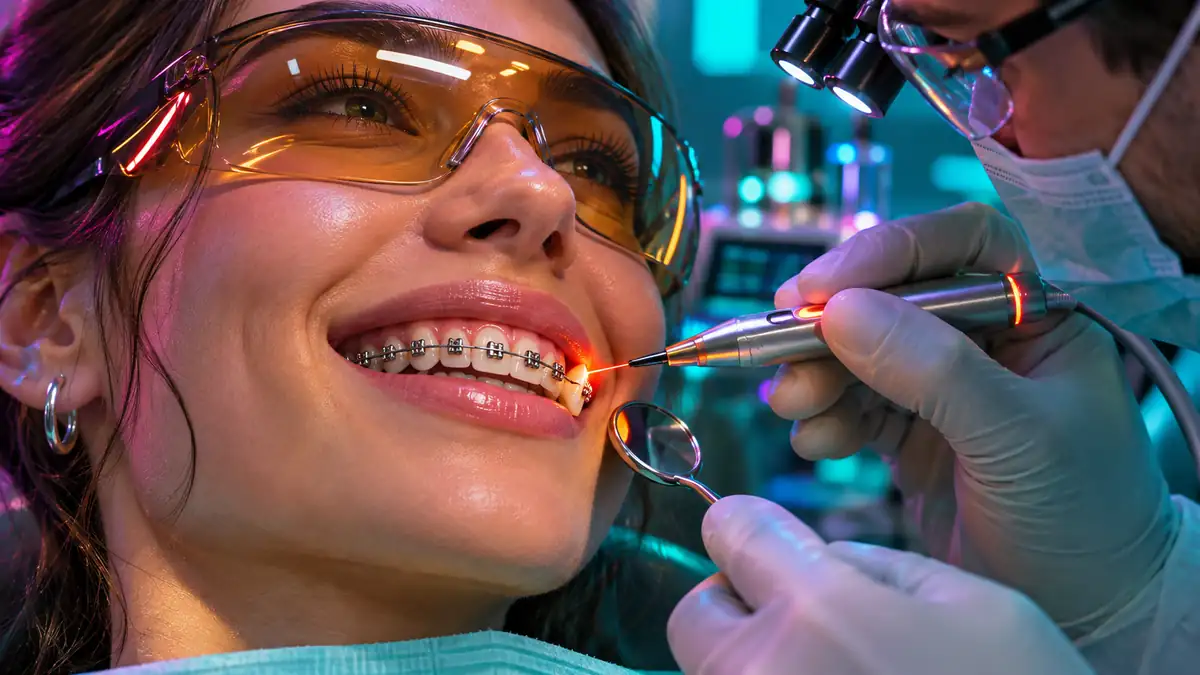
The laser was applied immediately after activation of the orthodontic appliance, then every two weeks for four months. The researchers measured canine movement each month. They also collected fluid from around the gums before activation and 14 days afterward to analyze two markers of bone remodeling.
Greater movement, not a measurement of total treatment time
After four months, average canine movement reached 4.95 mm on the laser-treated side, compared with 3.79 mm on the control side. The difference was statistically significant. This is a direct measurement of tooth movement, not just a biological change.
But this measurement concerns a specific stage of treatment. The abstract reports neither the time needed to complete the entire course of orthodontic treatment nor the long-term stability of the result. Presenting this trial as proof of shorter overall treatment would therefore go beyond the available findings.
Markers consistent with increased bone remodeling
Osteocalcin, a marker of bone formation, increased from baseline in the treated half-arches. N-telopeptide, a marker of bone resorption, was also higher on the laser-treated side than on the control side after activation.
These observations are consistent with a change in bone remodeling accompanying tooth movement. However, they are not enough to establish that these changes alone explain the laser’s effect, or to guarantee a lasting benefit.
Limitations to keep in mind
The study involved 30 adults and four months of follow-up in a specific orthodontic setting. Only the PubMed abstract was consulted, not the full text. Detailed randomization procedures, any blinding, and adverse effects are not described in this abstract. Funding and conflicts of interest could not be verified.
What we can take away
This trial suggests that a laser could speed up one phase of orthodontic tooth movement in some adults. It does not yet allow us to conclude that the full course of treatment is shorter, or to extrapolate its results to a consumer light device.
Sources and provenance
- Evaluation of the acceleration of orthodontic movements by applying low-level laser therapy. A randomized clinical trial.
Source date: 2026-11-10.
Journal Article, Randomized Controlled Trial · Résumé PubMed uniquement, texte intégral non consulté