

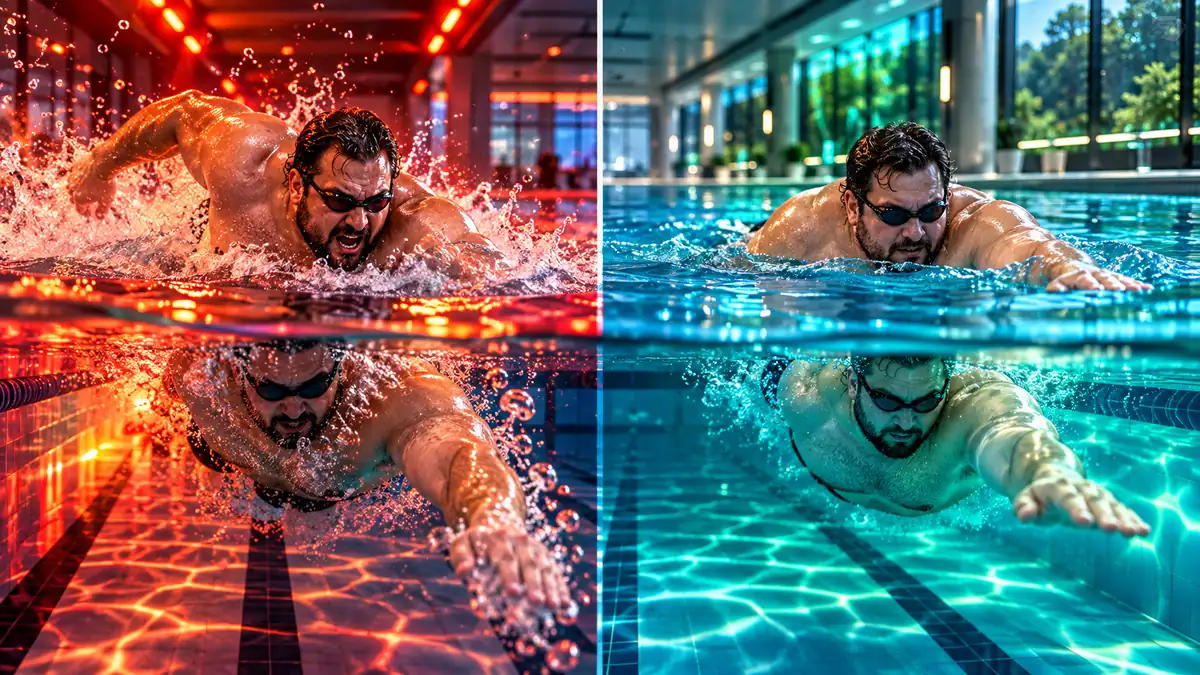
Three groups to compare two ways of swimming
The researchers plan to randomly assign 108 students with obesity to three groups of 36 participants: high-intensity interval freestyle swimming, moderate-intensity continuous swimming, and maintenance of usual activity.
The two swimming groups are scheduled to attend supervised 30-minute sessions, three times a week for six months. These parameters describe the experimental setup, not a recommendation to follow on your own. The abstract does not detail the intensities or the precise structure of the intervals.
The primary outcome will be total cholesterol at six months, accounting for its baseline value. Other metabolic, vascular, and anthropometric measurements are planned at baseline and at two, four, and six months. Attendance and safety will also be assessed.
Vascular markers, not proof of cardiovascular protection
The study will also seek to determine whether changes in markers of glucose and lipid metabolism are associated with changes in endothelin-1 and nitric oxide, two markers related to vascular function.
This analysis may explore relationships between metabolic and vascular responses. However, it will not be enough to establish that a metabolic change causes a vascular change. Any improvement in these markers would not, on its own, demonstrate a reduction in cardiovascular events either.
The primary analysis is planned according to the intention-to-treat principle, which keeps participants in their originally assigned groups. The protocol also outlines sensitivity analyses to examine the influence of missing data.
No reason to favor intervals based on this source alone
The value of the project lies in directly comparing the two swimming formats in the same population, with a control group maintaining its usual activity. But results are not available in the supplied document: there is no way to distinguish between the formats in terms of effectiveness, tolerability, or attendance.
The findings' scope will also depend on the population studied. Results obtained in students with obesity would not automatically apply to older people, trained swimmers, or patients with cardiovascular disease.
Limitations to keep in mind
Only the PubMed abstract was consulted, not the full text. No results are provided. Detailed intensities, exclusion criteria, funding, and conflicts of interest have not been verified. The planned outcomes are mainly biological markers, not clinical events.
What we can take away
This protocol asks a useful question but does not answer it. It provides no basis for choosing intense intervals over moderate continuous swimming.
Sources and provenance
- High-intensity interval versus moderate-intensity continuous freestyle swimming in obese college students: A randomized controlled study protocol examining glycolipid and vascular endothelial responses.
Source date: 2026-10-30.
Journal Article, Randomized Controlled Trial · Résumé PubMed uniquement, texte intégral non consulté