

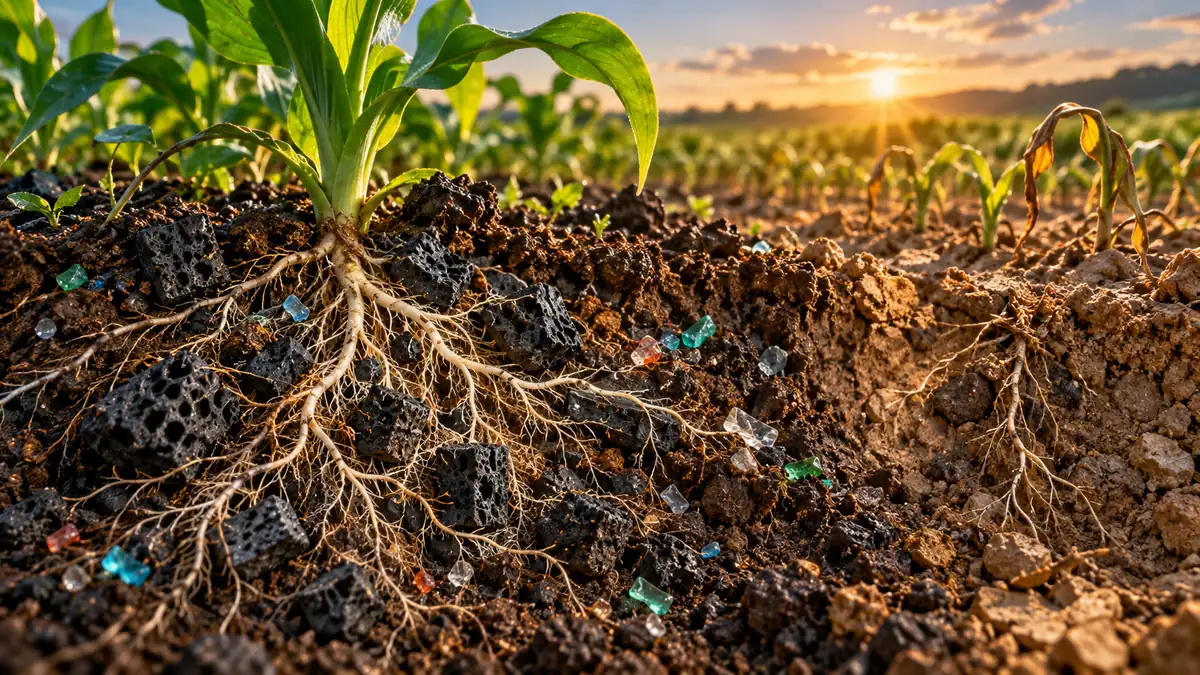
A synthesis of soil and plant responses
The researchers compiled 1,418 effect estimates from 59 peer-reviewed studies. Their aim was to assess the extent to which biochar mitigates the effects of microplastics and nanoplastics on soil properties and plant performance.
The analysis distinguishes between growing media, plant groups, plastic types, biochar feedstocks, application rates and production conditions, among other factors. However, the abstract consulted does not detail the comparators used in each experiment or the durations covered across the studies.
Beneficial results across several indicators
The pooled average effects are beneficial for soil properties, soil biological activity, biomass production, photosynthetic performance and plant nutrient content. Several indicators of oxidative damage also decrease.
The synthesis also reports a reduction in microplastic accumulation in plants. This finding concerns an experimental measurement in plants: on its own, it does not establish that the foods people eat contain less plastic or that eating them poses fewer risks.
The abstract does not provide the absolute values needed to translate these findings into an amount of plastic avoided in a harvest. Nor does it report the uncertainty intervals associated with the pooled effects.
Translation to field conditions remains the main limitation
Responses are stronger in controlled systems than in more complex environments. This gap limits the direct translation of experimental findings to real-world farming conditions.
Biochar application rate is the only continuous variable identified as significantly modifying the magnitude of the responses. This does not establish an optimal amount to use. Pyrolysis temperature and treatment duration are not significant linear predictors in this analysis, which does not demonstrate that they have no influence in every context.
The authors call for long-term field validation across more regions. At this stage, this synthesis supports a potential approach to managing contaminated soils, not an established method for protecting the human food supply.
Limitations to keep in mind
Only the Europe PMC abstract was consulted, not the full text. The findings depend heavily on the experimental context. The abstract does not allow a detailed assessment of study quality, comparators, durations or the precision of the estimates. Funding and conflicts of interest were not checked.
What we can take away
Biochar appears to mitigate several effects of plastics on soils and plants. Its effectiveness under real-world farming conditions and any implications for human dietary exposure remain to be established.
Sources and provenance
- Biochar mitigates microplastic- and nanoplastic-induced soil degradation and plant stress: a global meta-analysis.
Source date: 2026-10-20.
Meta-Analysis, IM, Review, Journal Article · Résumé Europe PMC uniquement, texte intégral non consulté