

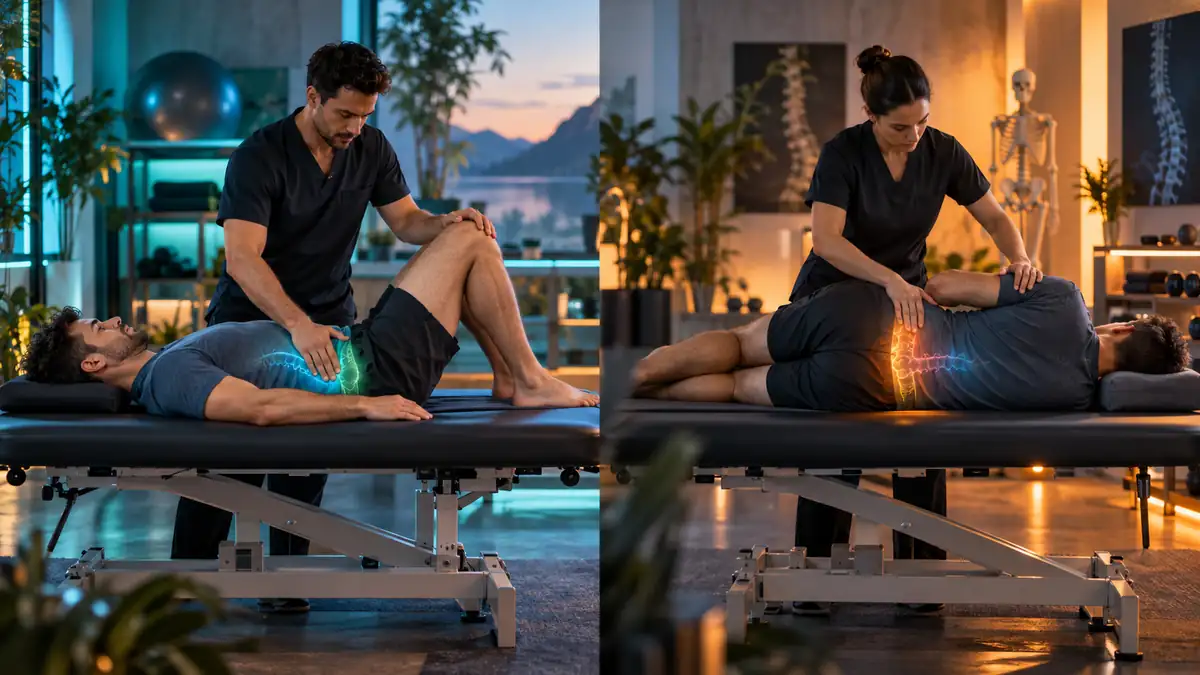
Measured forces, then simulated effects
The researchers randomly assigned 20 healthy volunteers to two rotational lumbar manipulation techniques: side-lying, known as lateral decubitus, or seated. Instrumented gloves recorded the forces applied by the practitioner.
These measurements were then used to define the loading conditions for a finite element model of the lumbar spine, described as validated in the abstract. This method simulates the distribution of stresses and displacements in the intervertebral discs and facet joint cartilage. The results concerning these tissues therefore come from the model, not from direct measurements in the participants’ backs.
An exploratory analysis identified two manipulation patterns in the side-lying position and three in the seated position, based on the distribution of forces across the shoulder, hip or waist. This variety suggests that position alone is not enough to describe mechanical loading.
Greater stress does not necessarily mean greater displacement
In the simulation, side-lying manipulation generally produced higher peak stresses but smaller displacements. The main mechanical effects were concentrated at the L3/L4 and L4/L5 levels, in the lower part of the lumbar spine.
Seated manipulation showed the opposite profile: generally lower stresses but larger displacements, with greater involvement of the L1/L2 and L2/L3 levels. A similar contrast appeared in the facet joint cartilage.
These results distinguish two dimensions that are often confused: the mechanical stress borne by a tissue and the extent of its deformation. A lower value for one does not guarantee a lower value for the other.
A basis for research, not a ranking of techniques
The abstract reports no improvement in pain, no functional gains and no comparison of injuries. The participants were healthy, so these observations cannot be directly applied to people with low back pain.
Higher simulated stress does not demonstrate damage, and lower stress does not demonstrate greater safety. The value of this study lies in clarifying where and how the two techniques load tissues, to guide future clinical research.
If you are trying to choose a manipulation technique to relieve low back pain, this study does not distinguish between the options. It compares their mechanics, not their clinical benefits or risks.
Limitations to keep in mind
The study involves 20 healthy volunteers and includes an exploratory classification of manipulation patterns. Tissue stresses and deformations come from a simulation. Only the supplied PubMed abstract was consulted, not the full text. Funding, conflicts of interest and the detailed model validation procedures were not verified.
What we can take away
The two positions produce distinct mechanical profiles in the model studied. Neither can be declared more effective or safer on this basis alone.
Sources and provenance
- Biomechanical comparison of lumbar rotational manipulations in two different positions using force measurement and finite element analysis.
Source date: 2026-10-05.
Journal Article, Comparative Study, Randomized Controlled Trial · Résumé PubMed uniquement, texte intégral non consulté