

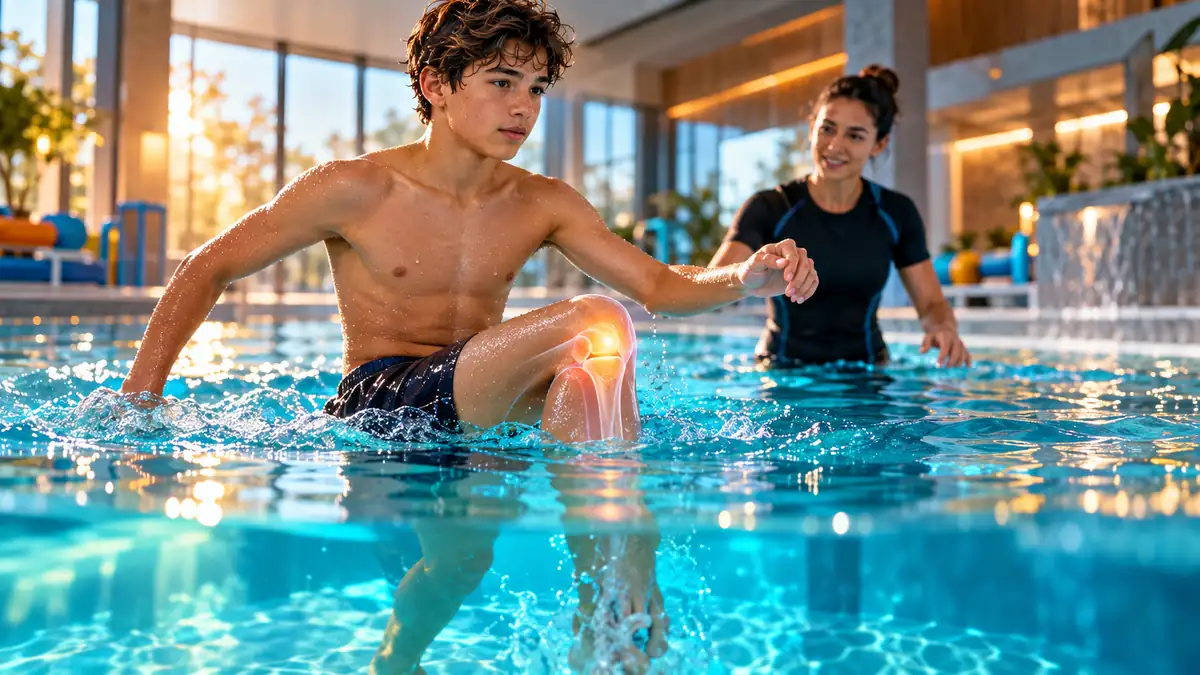
Two programs compared over 12 weeks
The researchers randomly assigned 56 adolescents aged 10 to 18 years to an aquatic plyometric program or a conventional exercise program. Both groups completed 45-minute sessions, twice a week, for 12 weeks. These parameters describe the intervention studied, not a prescription to follow.
Before and after the program, assessments covered pain intensity, quadriceps and hamstring strength, functional limitations, and health-related quality of life. Strength was measured as muscle torque during isokinetic testing, not as sporting performance on the field.
Favorable results, but practical benefits are hard to quantify
The abstract reports more favorable changes in the aquatic group for pain, strength of the muscles tested, functional limitations, and quality of life. For pain, the reported statistical difference reached p = 0.004. This supports the existence of a difference between the programs without directly indicating its importance for each adolescent.
The abstract provides neither mean scores before and after the intervention nor absolute differences between groups. From this information alone, it is impossible to say how much pain decreased or whether the advantage exceeds a threshold that participants would notice and find meaningful.
The comparator was also an exercise program. The trial therefore provides information about choosing between two rehabilitation approaches, not about the benefits of movement compared with no treatment.
A promising rehabilitation approach, not yet a new standard
Random allocation strengthens the value of this comparison. But the sample remains small, and the abstract does not precisely describe the conventional exercises, session adherence, or any dropouts. Nor does it report any follow-up beyond the end of the program.
Adverse events are not detailed in the available excerpt. The absence of any mention does not demonstrate that the program is safe. Funding and conflicts of interest were not checked.
These findings concern adolescents with patellofemoral pain syndrome. They are insufficient to draw conclusions about adults, other causes of knee pain, or injury prevention in athletes without symptoms.
Limitations to keep in mind
PubMed abstract only; full text not consulted. Absolute results, the clinical relevance of the differences, adverse events, and sustained benefits are not documented in the excerpt. Funding and conflicts of interest not checked.
What we can take away
This trial supports the potential value of aquatic plyometrics in rehabilitation for adolescent patellofemoral pain. It is not enough to establish this approach as the standard option or to determine whether the benefits persist.
Sources and provenance
- Clinical and functional outcomes of aquatic plyometrics in adolescent patellofemoral pain syndrome: a dual-arm randomized controlled trial.
Source date: 2026-10-19.
Journal Article, Randomized Controlled Trial · Résumé PubMed uniquement, texte intégral non consulté