

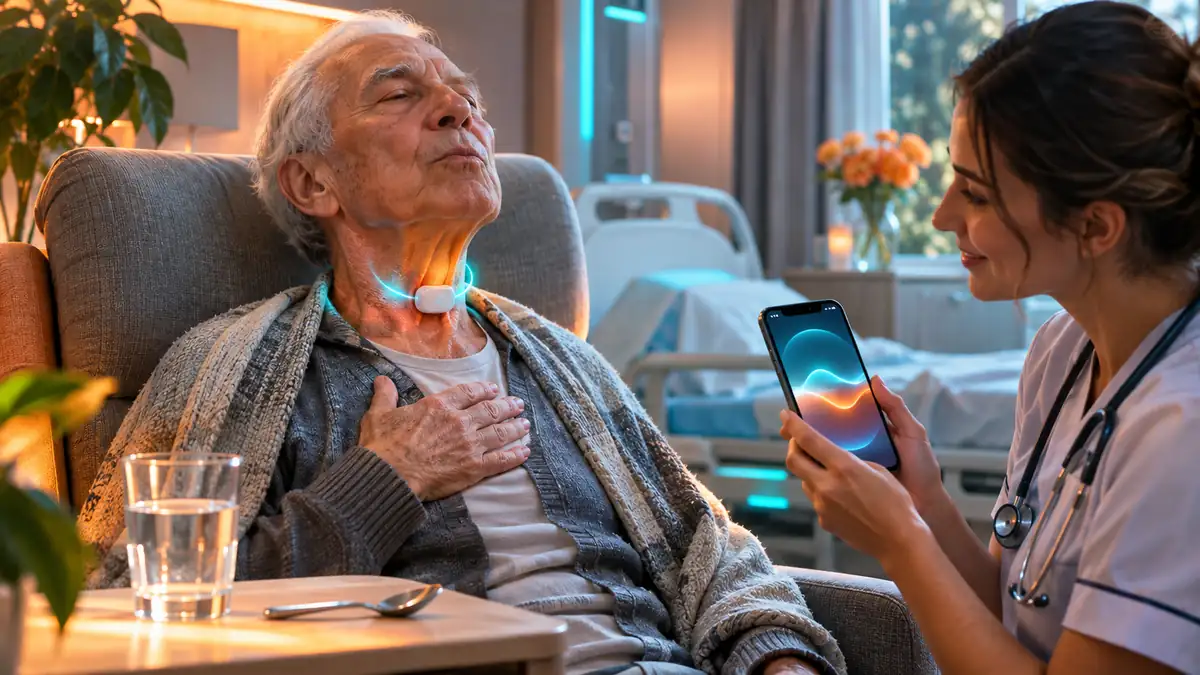
An exercise targeting the swallowing muscles
Swallowing difficulties, or dysphagia, are frequently associated with pneumonia requiring hospitalization in frail older adults. The intervention studied targets the muscles at the front of the neck involved in moving the larynx during swallowing.
The CTAR-SwiFt device includes a ball to compress under the chin and a mobile app providing real-time feedback. This feedback allows users to track their effort. The intended mechanism explains the choice of exercise, but is not enough to demonstrate improved swallowing safety.
A trial designed to prepare for a larger study
The researchers recruited medically stable people aged at least 75 who were hospitalized with pneumonia at two UK facilities. Of 75 people approached, 24 agreed to participate and 21 were randomly assigned to three groups: usual care, exercise once a day or exercise twice a day.
The intervention lasted 12 weeks, with a final assessment at 24 weeks. The main aim was to assess recruitment, retention, exercise adherence and device use, rather than establish effectiveness.
Only 11 of the 21 randomized participants completed the study. Medical problems, including declining health or readmission to hospital, were the main reason for not completing it.
Encouraging signals, without strong comparative evidence
The abstract reports favorable changes on two questionnaires screening for swallowing difficulties, the EAT-10 and the 4QT. By contrast, the effect on the scale assessing oral food intake, the FOIS, was minimal. An improvement in reported symptoms therefore does not necessarily mean an equivalent improvement in the ability to eat.
Participants also improved in the consistency of ball compression and the maximum force exerted under the chin. These measures describe exercise performance, not directly a reduction in dysphagia complications.
The once-daily exercise group showed the most favorable changes according to the abstract. However, it provides no detailed estimate of the differences between groups, so it is impossible to infer that one daily session is better than two.
What this trial changes
The main contribution is feasibility: some frail older adults can use this device after pneumonia. However, difficult recruitment and numerous dropouts highlight the obstacles to a larger study.
These results justify further evaluation, not a recommendation to exercise independently. They demonstrate neither fewer new cases of pneumonia nor fewer hospital readmissions.
Limitations to keep in mind
Only the PubMed abstract was consulted, not the full text. The sample is small, and nearly half of the randomized participants did not complete the study. Differences between groups and adverse events are not detailed in the abstract provided. Funding and conflicts of interest were not checked.
What we can take away
CTAR-SwiFt appears usable by some frail older adults after pneumonia. Its effectiveness in improving swallowing and reducing its complications remains to be established.
Sources and provenance
- Chin Tuck Against Resistance Exercise With Feedback to Improve Swallowing, Eating, and Drinking in Frail Older People Admitted to Hospital With Pneumonia (CTAR-SwiFt): Randomized Controlled Feasibility Study.
Source date: 2026-11-13.
Journal Article, Randomized Controlled Trial · Résumé PubMed uniquement, texte intégral non consulté