

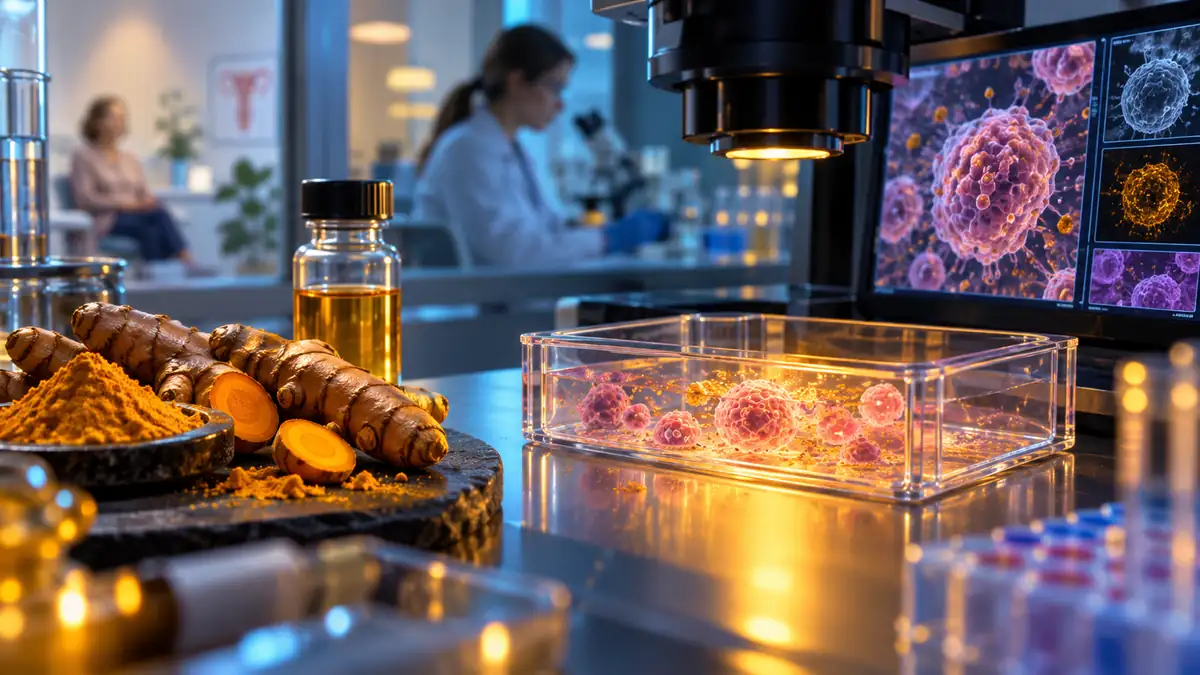
A review focused on preclinical models
The authors examined the effects of curcumin, a polyphenol derived from Curcuma longa, as well as formulations designed to modify its delivery. Their review covers preclinical models of ovarian cancer, not a demonstration of efficacy in patients.
The available source material contains only the PubMed abstract. It does not allow verification of experimental sample sizes, doses, intervention durations or the methodological quality of each of the 21 studies. The number of studies alone therefore does not establish the robustness of the findings.
Several possible mechanisms, but no clinical evidence
According to the abstract, curcumin could affect several signalling pathways, including PI3K/Akt/mTOR, NF-κB, JAK/STAT3 and Wnt/β-catenin. In the models studied, these interactions are associated with increased programmed cell death, reduced proliferation and inhibition of epithelial–mesenchymal transition.
The studies also report increased sensitivity to chemotherapy agents such as cisplatin and paclitaxel. This is an experimental avenue, not proof that combining a curcumin supplement with these treatments improves their efficacy in a patient.
A possible change in the tumour microenvironment, through tumour-associated macrophages, is also discussed. However, the authors note that this hypothesis is still based on limited data.
Nanoformulations do not validate commercially available supplements
The abstract reports that micelles, dendrosomes, liposomes and core–shell nanoparticles improve curcumin's bioavailability and experimental performance compared with its free form. These findings apply to the formulations studied, not automatically to products sold as supplements.
Better bioavailability does not, on its own, demonstrate a clinical benefit. The abstract provides neither an estimate of an effect in patients nor data that would allow assessment of the safety of combining curcumin with chemotherapy.
What this review changes
This review clarifies the mechanisms and formulations to explore in future research. It does not justify replacing cancer treatment or adding curcumin on your own initiative. If you are considering a supplement during treatment, discuss it with your oncology team.
Limitations to keep in mind
Only the PubMed abstract was consulted, not the full text. Detailed methods, effect sizes, study quality, safety data and clinical applicability cannot be assessed from the source material. Funding and conflicts of interest were not verified.
What we can take away
Curcumin remains an avenue of research in ovarian cancer. This preclinical review does not demonstrate a therapeutic benefit in patients.
Sources and provenance
- Curcumin in ovarian cancer: mechanistic insights and translational potential.
Source date: 2026-10-09.
Journal Article, Systematic Review, Review · Résumé PubMed uniquement, texte intégral non consulté