

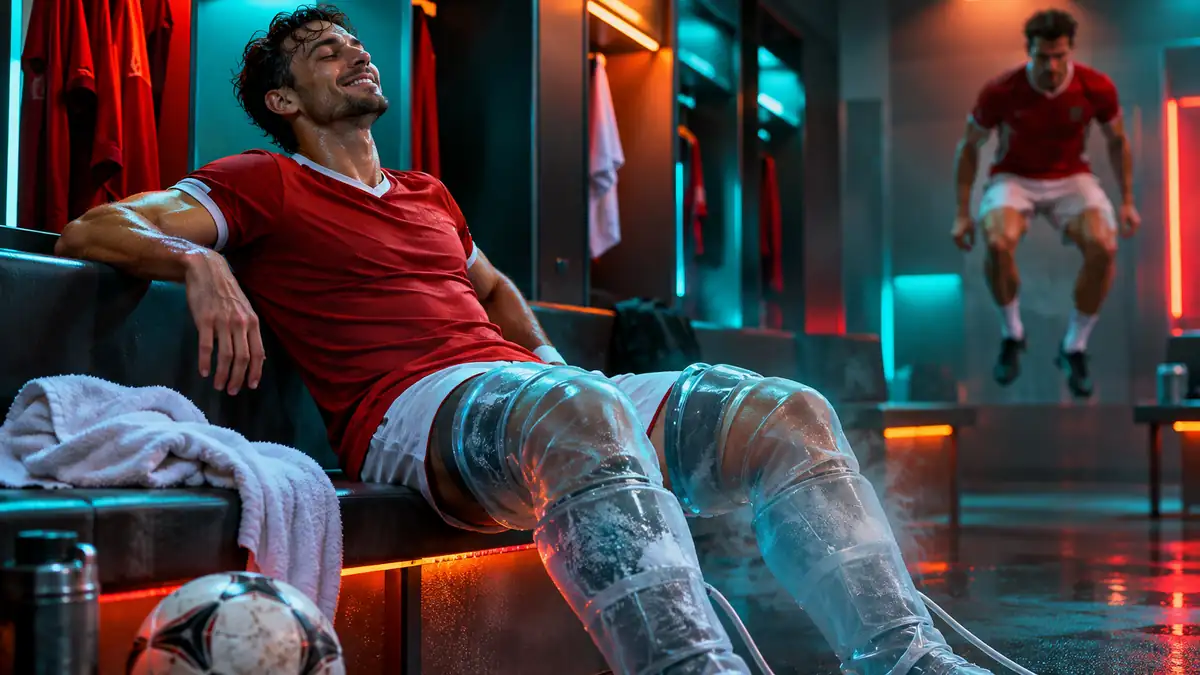
Two pressure levels compared after exercise
The researchers studied the immediate responses of the gastrocnemius, a calf muscle, after a 90-minute football-specific fatigue protocol. Each participant received both cold compression treatments in separate sessions, 48 hours apart.
The intervention lasted 20 minutes at 1 °C. Pressure ranged from 5 to 15 mmHg in the low-pressure condition and from 5 to 50 mmHg in the moderate-pressure condition. These settings describe the experiment, not a recommended protocol.
Before and after the intervention, the researchers assessed pain, perceived fatigue, jump performance, and the muscle’s mechanical and architectural properties.
Perception and performance do not follow the same trajectory
Perceived pain and fatigue decreased after the interventions. However, the abstract reports no statistically significant difference between the two pressure levels for these outcomes. Nor does it provide the absolute magnitude of the improvement, making it impossible to assess its practical importance.
At the same time, countermovement jump height, peak force and peak power decreased after the intervention. These findings show a mismatch between perceived relief and measured physical capabilities. They do not demonstrate that cold compression causes this decline, since the study includes no condition without an intervention.
Differences in changes between the pressure levels were detected for the rate of force development and a mechanical measure of the lateral gastrocnemius. However, no significant change in the rate of force development was observed within either condition. This signal therefore remains exploratory, not evidence that one pressure level is preferable.
No optimal pressure established
With only seven participants and measurements limited to the immediate post-session period, this trial cannot support conclusions about next-day recovery, performance in a subsequent match or the effects of repeated use.
The useful distinction is this: a reduction in pain after a recovery session is not enough to demonstrate that athletic capabilities have returned. This study cannot establish an optimal pressure or show that cold compression improves recovery more than rest.
Limitations to keep in mind
Only seven male university footballers, no comparator without an intervention, and follow-up limited to immediate responses. The absolute magnitudes of the changes are not provided in the abstract. Only the PubMed abstract was consulted, not the full text. Funding and conflicts of interest were not checked.
What we can take away
In this small trial, perceived relief was not accompanied by an immediate improvement in performance. No practical superiority of either pressure level has been established.
Sources and provenance
- Immediate gastrocnemius responses to intermittent cold compression at different pressure levels in soccer players.
Source date: 2026-11-05.
Journal Article, Randomized Controlled Trial · Résumé PubMed uniquement, texte intégral non consulté