

A review focused on school environments
The researchers brought together 35 peer-reviewed studies published between 2015 and 2025 and identified through five databases. Their question concerns outdoor thermal comfort in schools, from kindergarten through secondary school.
The studies focus mainly on reducing summer heat stress, particularly in primary schools in Mediterranean and humid subtropical climates. This distribution limits the applicability of the conclusions to other climates and seasonal conditions.
Shade and vegetation stand out, but no quantified effects are available
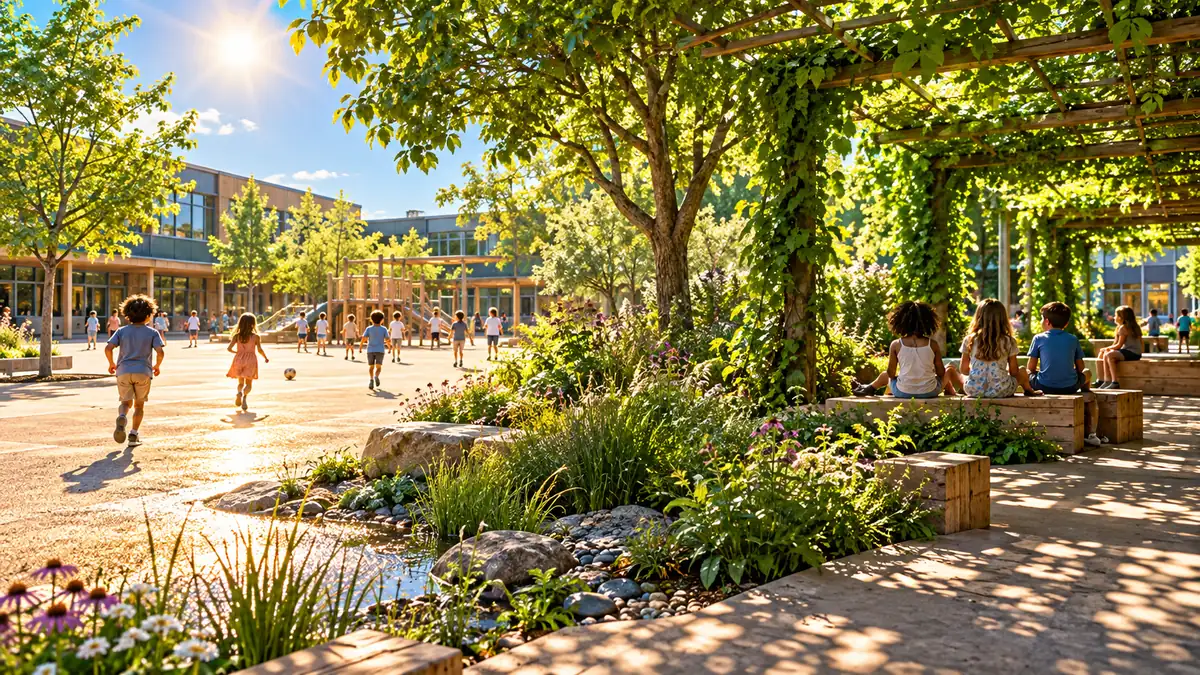
According to the abstract, vegetation and shade consistently emerge as the most effective mitigation strategies across the climates studied. This places them among the priority options to consider when designing a schoolyard.
However, the abstract provides no quantified temperature reduction, overall estimate of improved comfort or detailed comparison between design options. It therefore cannot identify a universal solution or predict the outcome at a particular school.
Measuring comfort is not enough to demonstrate a health benefit
Most studies combine field measurements with numerical simulations, generally using objective thermal comfort indices. The review also notes the growing integration of subjective and behavioral dimensions, including behavioral adaptation.
These findings primarily concern the thermal environment. The abstract reports no measured effects on heat-related illnesses, attention or academic performance. The authors call for more integrated and participatory approaches, rather than a purely technical view of schoolyards.
Limitations to keep in mind
Only the PubMed abstract was consulted, not the full text. It does not detail study quality, sample sizes, durations, comparators or effect sizes. Funding and conflicts of interest were not checked.
What we can take away
Shade and vegetation are the options most strongly highlighted by this review for improving thermal comfort in schoolyards. Their potential value should not be turned into a quantified promise of better health or learning.
Sources and provenance
- Outdoor thermal comfort in K-12 schools: a systematic literature review.
Source date: 2026-10-26.
Journal Article, Systematic Review, Review · Résumé PubMed uniquement, texte intégral non consulté