

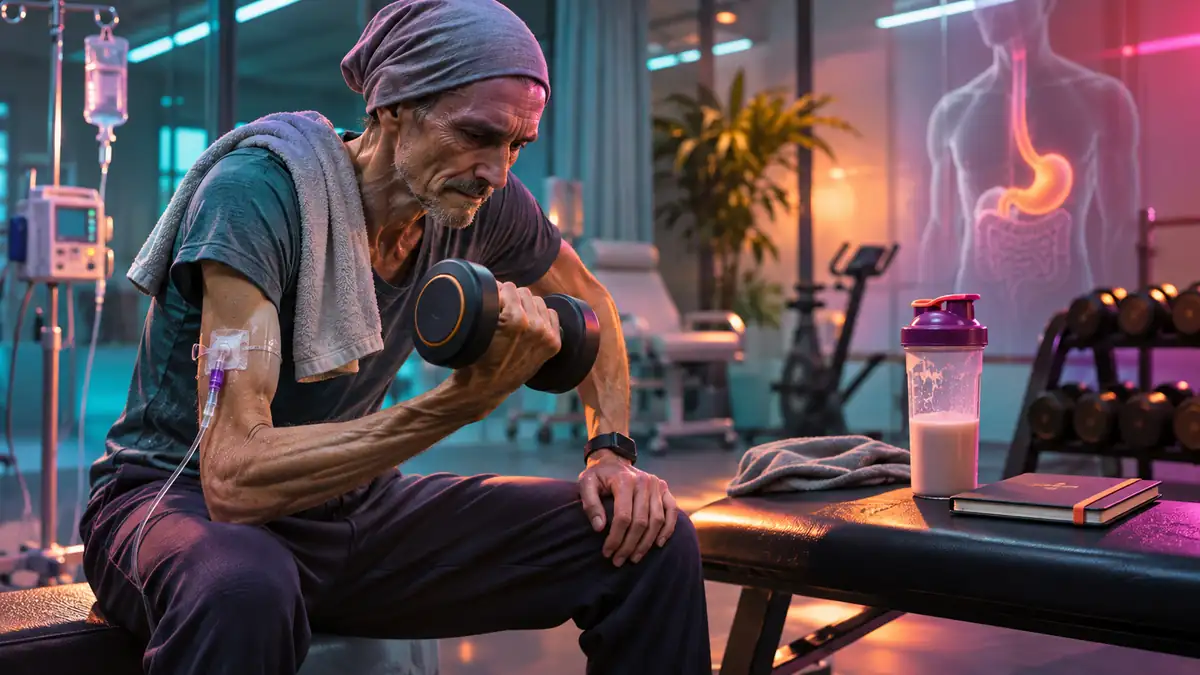
A trial focused on feasibility during chemotherapy
Cancer cachexia is associated with reduced physical function, quality of life and survival. The researchers assessed whether patients about to start first-line chemotherapy for incurable gastroesophageal cancer could follow a program combining resistance training and protein supplementation.
The randomized, unblinded trial compared a group offered three training sessions per week and daily protein supplementation with a control group. Its primary objective was feasibility, assessed through recruitment, retention, adherence and adverse events. The available abstract does not specify the program’s duration or the amount of protein.
Staying in the study does not mean following the program
Of 106 potentially eligible patients, 20 were randomized, giving a recruitment rate of 19%. Of these, 18 completed the trial. This high retention contrasts with more limited adherence to the interventions.
Median adherence was 63% for strength training sessions and 39% for protein supplements. Only five participants in the intervention group, or 38%, met the minimum feasibility criteria for both components. The abstract details neither these thresholds nor the reasons for low adherence.
The authors conclude that this combination, in the form tested, was not feasible during first-line chemotherapy because of low recruitment and poor adherence to supplementation.
Neither demonstrated benefit nor proof of ineffectiveness
No between-group differences were detected in body composition, physical function, quality of life or treatment tolerance. With only 20 participants and limited adherence, this lack of difference does not demonstrate that strength training or protein is ineffective.
No serious adverse events related to the intervention were reported. However, this finding in a small sample is not enough to establish the program’s safety for all patients concerned.
The trial’s main contribution therefore concerns implementation: the program tested proved difficult to follow in this clinical setting. These findings cannot be generalized to healthy people, other cancers or other forms of support.
Limitations to keep in mind
Only the PubMed abstract was consulted, not the full text. The trial is small, unblinded and focused on feasibility. The abstract does not specify the duration, protein dose, details of the control group or reasons for low adherence. Funding and conflicts of interest could not be verified.
What we can take away
This trial highlights a feasibility problem, not a verdict on the effectiveness of strength training or protein against cancer cachexia.
Sources and provenance
- Resistance training and protein supplementation in patients with incurable gastroesophageal cancer: a randomized feasibility trial.
Source date: 2026-11-05.
Journal Article, Randomized Controlled Trial · Résumé PubMed uniquement, texte intégral non consulté