

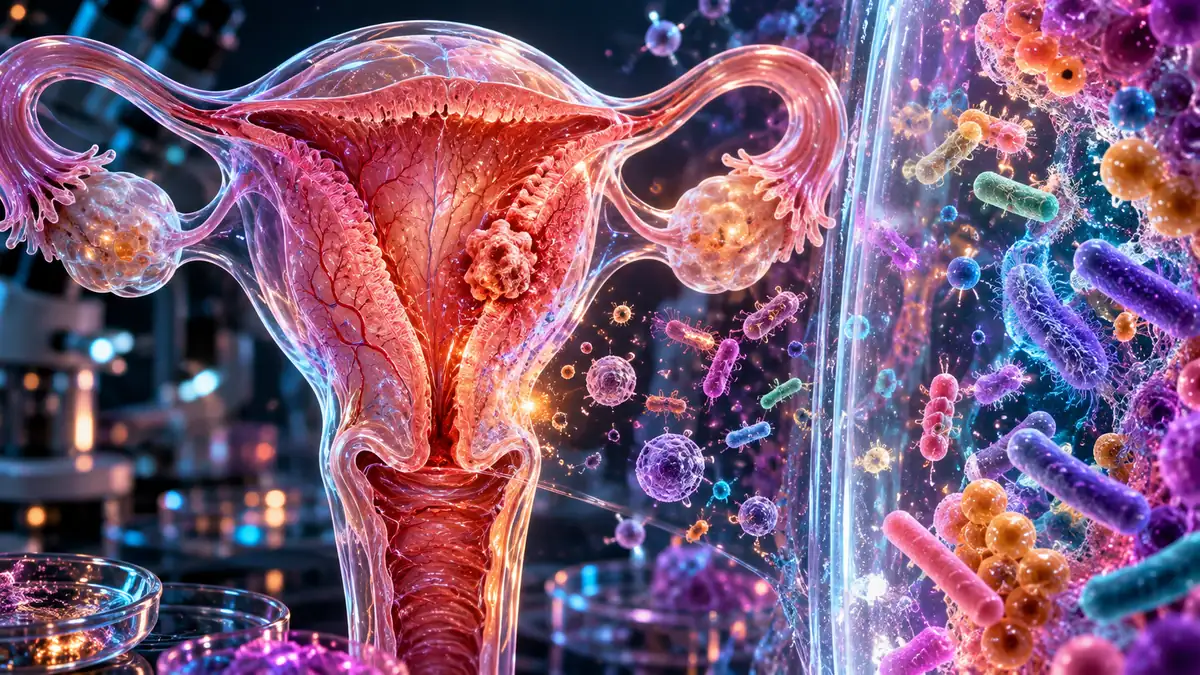
Ten studies comparing several clinical conditions
The review brings together ten observational studies including 329 women with benign conditions, 121 with endometrial hyperplasia and 325 with endometrial cancer. The researchers examined clinical characteristics, sampling sites and microbiological data.
The cancers were predominantly endometrioid, low-grade and early-stage. The findings therefore mainly describe this patient profile, rather than all forms of endometrial cancer.
Bacterial differences, not a validated diagnostic signature
According to the abstract, several bacterial genera, including Lactobacillus, Bacteroides and Prevotella, were less represented in cancer cases. Conversely, Stenotrophomonas, Streptococcus and Porphyromonas were more represented. The pooled analysis reports an association between an imbalance in the genital microbiota and endometrial cancer.
These findings do not allow each bacterium to be classified as protective or responsible for the disease. Nor do they show how reliably a sample could distinguish a woman with cancer from a woman with a benign condition: the abstract does not provide the diagnostic performance data needed to determine this.
Age and body size complicate interpretation
Women with cancer were older on average and had a higher body mass index than those with benign conditions. These differences between groups may complicate interpretation of the association. The abstract does not allow us to verify how far the analyses account for them.
Chronic inflammation, immune dysregulation and metabolic disturbances are biological hypotheses discussed by the authors. They do not demonstrate that bacterial changes precede cancer or contribute to its development. The data presented cannot distinguish between cause, consequence and shared factors.
A research lead, not yet a clinical tool
The authors consider these microbial profiles to be potential complementary markers for assessing risk or supporting early detection. This usefulness still needs to be established in large prospective studies, using standardized sampling, sequencing and analysis methods.
This review does not demonstrate that an intervention targeting the microbiota prevents or treats endometrial cancer. Its contribution is more limited: it identifies an association to explore, without validating any diagnostic or therapeutic application.
Limitations to keep in mind
Only the Europe PMC abstract was consulted, not the full text. It does not detail the magnitude of the pooled association, its uncertainty, study heterogeneity or the adjustments made. Funding and conflicts of interest were not verified.
What we can take away
A different genital microbiota is associated with endometrial cancer in this review. This warrants further research, but not yet a clinical test or a treatment targeting these bacteria.
Sources and provenance
- From Dysbiosis to Malignancy: The Female Genital Tract Microbiome in Endometrial Cancer; Insights from a Systematic Review and Meta-Analysis.
Source date: 2026-11-01.
Meta-Analysis, Systematic Review, Journal Article · Résumé Europe PMC uniquement, texte intégral non consulté