

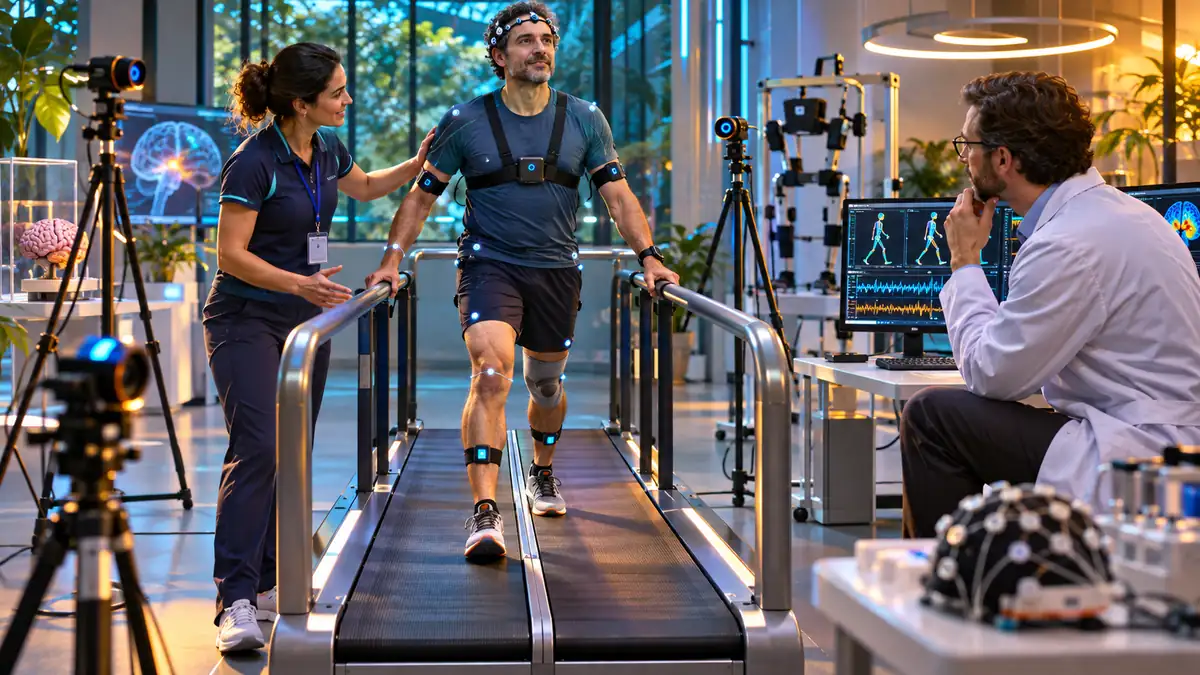
Two walking approaches compared in hospital
This randomized trial was conducted in the rehabilitation department of a single hospital among patients with hemiplegia in the subacute phase after stroke. The median time since stroke was 13 days. Of the 30 participants assigned to the two groups, 26 completed the post-intervention assessment, with 13 in each group.
In the experimental group, the paretic leg was placed on the slower belt, which moved at half the speed of the other belt. In the control group, both belts moved at the same speed. The sessions replaced usual walking training within the inpatient rehabilitation program.
The researchers compared balance after three weeks, as well as functional reach, walking speed and basic activities of daily living. The assessor did not know which group patients had been assigned to.
Improvement in both groups, with no demonstrated advantage
The Berg Balance Scale score increased by an average of 18.8 points with the belts moving at different speeds, compared with 18.0 points with the belts moving at the same speed. But this improvement within each group does not demonstrate that the experimental approach provides an additional benefit.
After adjustment for baseline values, the difference between the groups was 1.20 points. Its 95% confidence interval ranged from −5.30 to 7.71 points and therefore included no difference. This small trial demonstrates neither the superiority of the device nor the equivalence of the two approaches.
No secondary outcome remained statistically significant after correction for multiple comparisons. A favorable signal for seated functional reach did not hold up after this correction or in sensitivity analyses. It remains exploratory.
Feasibility alone does not establish efficacy
The session completion rate reached 99.7%, and no adverse events related to the device or protocol were reported. These findings support its feasibility under the conditions of this hospital trial, without establishing its safety in other settings or among other patients.
The practical distinction is clear: a device can be well tolerated without producing greater improvements in clinical outcomes. A larger trial would be needed to determine whether this approach offers an advantage after stroke.
Limitations to keep in mind
Small, single-center pilot trial, with an assessment after three weeks and four participants missing the final assessment. The dossier contains only the PubMed abstract, not the full text. Funding and conflicts of interest have not been verified.
What we can take away
This trial provides no evidence to favor a split-belt treadmill over belts moving at the same speed after stroke. It mainly supports the feasibility of this approach in inpatient rehabilitation.
Sources and provenance
- Effects of slow-belt split-belt treadmill training on balance, walking speed, and activities of daily living in patients with subacute stroke: A pilot randomized controlled trial.
Source date: 2026-11-13.
Journal Article, Randomized Controlled Trial · Résumé PubMed uniquement, texte intégral non consulté