

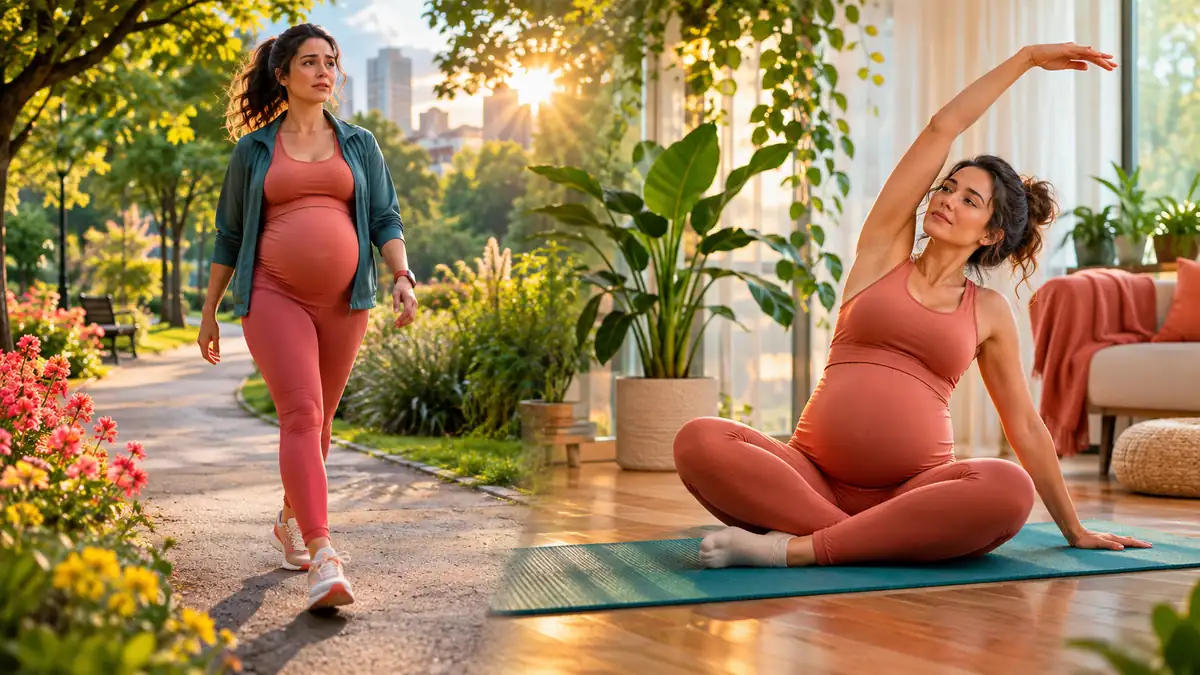
Two interventions compared in the third trimester
The researchers used data from the Prenatal Heart Smart trial. Participants had been randomly assigned to moderate-intensity walking, with 42 participants, or light-intensity stretching, with the other 34.
They completed the State-Trait Anxiety Inventory at around weeks 28, 32 and 37 of pregnancy. This tool distinguishes anxiety related to the current situation, known as state anxiety, from a more general tendency to experience anxiety, known as trait anxiety.
Between-group comparisons accounted for baseline anxiety and repeated measurements. The abstract provided does not specify session frequency or duration, so these results cannot be used to describe a reproducible program.
No difference detected, but no equivalence demonstrated
No statistically significant difference was observed between walking and stretching for either dimension of anxiety at follow-up assessments. This finding does not demonstrate that the interventions are equivalent, particularly given the limited sample size.
The researchers then pooled the participants to examine changes over the course of pregnancy. Mean state anxiety scores were 30.0, then 29.6 and 29.6. Trait anxiety scores were 31.1, then 32.1 and 30.4. No statistically significant change was detected.
The crucial point is the comparator: both groups received a physical activity intervention. Without a non-exercise group, there is no way to know whether activity contributed to this stability or whether it would have been observed anyway.
Limited relevance for people with high anxiety levels
Baseline anxiety was relatively low. These observations therefore do not establish the effectiveness of walking or stretching in people with high anxiety levels, nor can they be generalized to all pregnancies.
Exploratory analyses also found no significant association between changes in anxiety and gestational hypertension after adjustment. There were too few cases of preeclampsia to analyze. These findings do not establish a protective effect against these complications.
Limitations to keep in mind
Secondary analysis involving 76 participants with obesity and relatively low baseline anxiety, without a non-exercise group. Only the PubMed abstract was consulted, not the full text. Funding, conflicts of interest and safety data were not verified.
What we can take away
This analysis provides no reason to favor moderate walking over light stretching to reduce anxiety in this population. Nor does it demonstrate that either intervention prevents anxiety from worsening.
Sources and provenance
- State and trait anxiety following prenatal moderate- versus light-intensity exercise: a secondary analysis of a randomized trial.
Source date: 2026-11-18.
Journal Article, Randomized Controlled Trial · Résumé PubMed uniquement, texte intégral non consulté